Animal disease control fence in tatters
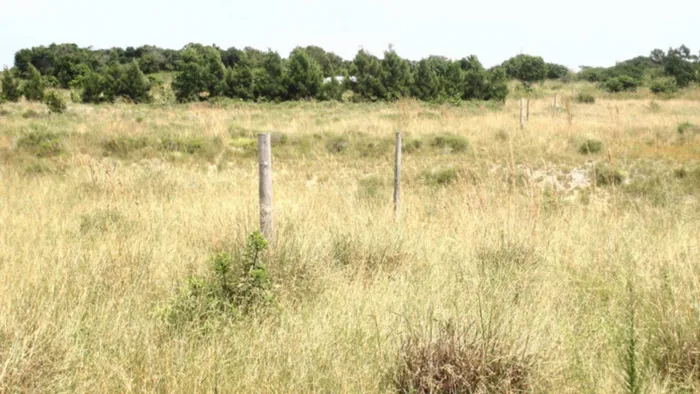
Wooden poles stripped bare of wire& The remnants of the secondary 'red line' animal disease control fence near Kosi Bay on the border between Mozambique and KwaZulu-Natal. Picture: Sandy la Marque. Wooden poles stripped bare of wire& The remnants of the secondary 'red line' animal disease control fence near Kosi Bay on the border between Mozambique and KwaZulu-Natal. Picture: Sandy la Marque.
TONY CARNIE
As farmers count the cost of lost income from the ban on meat industry exports, the government has come in for renewed criticism for its handling of the foot-and-mouth outbreak – including measly state budgets to repair collapsing “red line” animal disease fences.
It emerged in Parliament last week that only R12 million a year was allocated throughout the country to maintain animal disease control fences with five neighbouring countries and that subsidies from the Public Works Department were “never sufficient”.
In northern KwaZulu-Natal, where the outbreak began early this year, nothing has been done for 36 months to repair the eastern boundary fence of Ndumo game reserve, despite the high risk of disease transmission between wild animals and cattle.
There are also question marks around the ability of animal health inspectors to monitor the domestic transmission of disease in areas bordering the Kruger National Park, where the disease is endemic in buffalo.
Responding to questions from the DA in Parliament, national Agriculture Minister Tina Joemat-Pettersson appeared to shift the blame to the national Department of Public Works and the SANDF, arguing that her department was never allocated enough money to look after animal disease control fences.
While the exact source of the latest disease outbreak in KZN remains unclear, South Africa has been forced to suspend all exports of unprocessed cattle, sheep, pig and other cloven-hoof animal products.
Scientists at the Onderstepoort Veterinary Institute managed to isolate two virus types in cattle and buffalo in northern KZN. Some cattle were found with the SAT 1 virus while several buffalo in Ndumo game reserve had the SAT 3 virus – indicating that the cattle were not infected from Ndumo buffalo.
Dr Mpho Maja, the national director of animal health, said a disease transmission route from Mozambique seemed unlikely as the infected Mozambican cattle had a different virus strain and the outbreak happened about 200km north of Maputo.
Instead, the Agriculture Department appeared to indicate a link between the SAT 1 virus found recently in northern KZN and a similar virus strain common in the northern section of the Kruger National Park in Limpopo.
However, DA agriculture spokesman and former Agri SA president Dr Lourie Bosman said he found it highly unlikely that the KZN outbreak could be linked to the northern part of Kruger because of the vast distance and the fact that there was very little movement of cattle between Limpopo and KZN.
“The most likely theory remains that the disease came in from Mozambique,” Bosman maintained.
KwaNalu farm union chief executive Sandy la Marque, who visited northern KwaZulu-Natal two weeks ago, said R27m had been allocated to the provincial Agriculture Department to repair the secondary disease control fence four years ago, but this fence remained in tatters. It lies about 20km south of the international border between the two countries.
Meanwhile, Joemat-Pettersson confirmed, that her department was in “constant liaison with the newly created Border Management Agency about the integrity of border fencing from an animal health perspective.