Etruscan secrets found on ancient slab
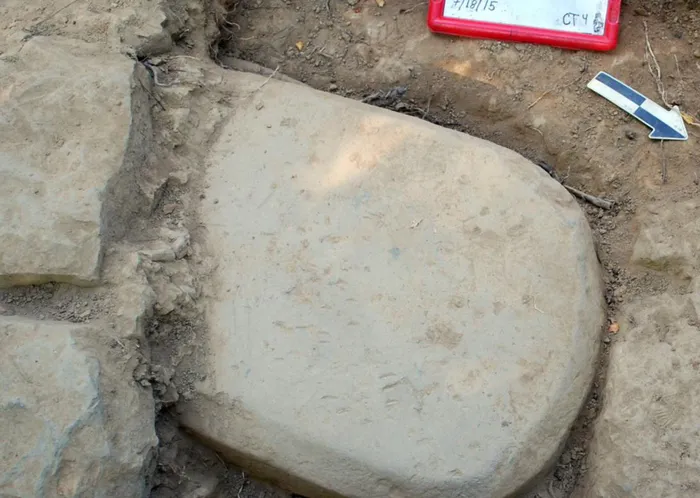
The stone slab was embedded in the foundations of a monumental temple where it had been for more than 2 500 years. Picture: @physorg_com/Twitter The stone slab was embedded in the foundations of a monumental temple where it had been for more than 2 500 years. Picture: @physorg_com/Twitter
Rome - An ancient stone tablet, discovered by archaeologists at a dig outside Florence, is being hailed as “Italy's Rosetta stone”, with excited experts saying the 2 500-year-old artefact will provide remarkable insights into the ancient Etruscans.
This mysterious but highly cultured race, which colonised large parts of central and northern Italy, built a civilisation that is regarded in many ways as a model for the ancient Greek and Roman cultures that followed it.
The tablet, which is 4 feet long, contains 70 legible letters and punctuation marks, many of which are new to archaeologists. Experts know very little about the Etruscan language, because they wrote mostly on perishable objects such as wax tablets.
“We hope to make inroads into the Etruscan language,” said Gregory Warden, head of the research team and professor of archaeology at Franklin University, in Lugano, Switzerland.
“Long inscriptions are rare... so there will be new words that we have never seen before, since it is not a funerary text.”
He said that given how much the ancient Etruscans had influenced the Roman and Greek civilisations from which our own cultures had developed, “the chance to learn more about their world is an incredible opportunity”.
Enrico Benelli, an expert on the Etruscans at Rome's National Research Council told La Repubblica that a few very limited bilingual texts written in both Etruscan and Phoenician had previously been discovered, but that they were too small to reveal much vocabulary. In addition, those translations appeared to be inconsistent.
Use of laser scanning devices will help the researchers glean language from parts of the stone that are worn. Professor Rex Wallace, an Etruscan specialist at the University of Massachusetts Amherst, will lead the project to translate the tablet.
The archaeologists found the stone slab, which weighs about 220 kilograms, embedded in the foundations of a large temple in the Poggio Colla area of the large Mugello Valley excavation site, north-east of Florence, where it had been buried for more than 2 500 years.
At one time it would have been displayed as an important symbol of authority, Professor Warden said.
The Independent