

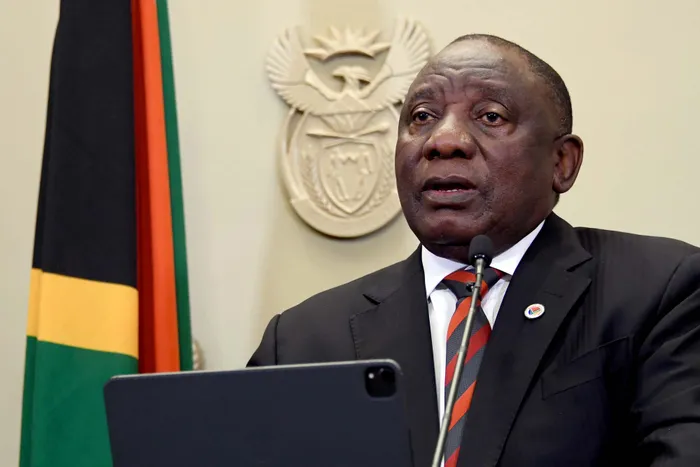
President Cyril Ramaphosa. Picture: Elmond Jiyane/GCIS
Durban - A drop in hospital admissions of those with Covid-19 infections has prompted President Cyril Ramaphosa to relax restrictions on the sale of alcohol and to allow access to beaches, rivers and other places of entertainment.
Detailing his reasons, the president said the number of new infections, hospital admissions and deaths had declined and Cabinet had decided to steadily ease a number of restrictions under adjusted level 3.
“The hours of the curfew will now be from 11pm to 4am. Establishments will need to close by 10pm to allow their customers and staff to return home by curfew,” Ramaphosa said.
He said faith-based gatherings would be permitted, subject to health protocols, saying such gatherings may not exceed 50 people for indoor venues and 100 persons for outdoor venues.
Where the venue was too small to accommodate these numbers with appropriate social distancing, then no more than 50% of the capacity of the venue may be used.
“Public places such as beaches, dams, rivers, parks and public swimming pools will be reopened subject to health protocols. Restrictions on the sale of alcohol will be eased.
“The sale of alcohol by licensed premises for off-site consumption will be permitted from Mondays to Thursdays, from 10am to 6pm.
“Duty-free shops, registered wineries, wine farms, micro-breweries and micro-distilleries will be able to sell alcohol for off-site consumption during their normal licensed operating hours.
“The sale of alcohol by licensed premises for on-site consumption – such as restaurants and taverns – will be permitted throughout the week from 10am to 10pm,” he said.
Ramaphosa said these changes had been made possible by the significant reduction in Covid-19 hospital admissions across all provinces, reducing the pressure on beds and hospital personnel.
“I want to call on all of us to drink responsibly so that we do not experience a spike in trauma cases or an increase in infections due to reckless behaviour.
“As we ease restrictions once again, the responsibility on each and every one of us as individuals becomes even greater,” Ramaphosa said.
He said the government was pleased that across the country, most people were adhering to the restrictions and observing the basic health measures needed to prevent infection.
“I want to thank the millions of South Africans who had to endure restrictions on their movement and activities so that infections could be contained, and lives could be saved,” the president said. “You have understood
that no walk on the beach, no picnic in the park, and no late-night party is worth the loss of life that has been prevented by these restrictions.
“While these restrictions are temporary, the loss of life is permanent.
“Nevertheless, we know that the measures necessary to contain the spread of the virus have caused great hardship and difficulty for some people,” Ramaphosa added.
He said the government was acutely aware that these restrictions had negatively affected businesses and threatened jobs in the hospitality, tourism and related industries.
“That is why we are determined that such restrictions should not continue any longer than is absolutely necessary to contain the pandemic and minimise the loss of life.
“It is for this reason that we will continue to work with business and labour in these sectors to revive businesses and restore jobs both in the immediate and longer term.
“Over the last few days, we have assessed the state of the pandemic. We have sought the advice of experts and consulted with representatives of provincial and local government and traditional leaders,” Ramaphosa said.
He addressed the nation after the arrival of the first batch of one million doses of vaccines from India yesterday.
“This vaccine was developed by the pharmaceutical company AstraZeneca together with the University of Oxford. South Africa was one of the countries where clinical trials were held to assess the drug’s efficacy,” Ramaphosa said.
He said the arrival of these vaccines contained the promise of turning the tide on the disease.
“The speed and scale at which new vaccines have been developed is unprecedented in human history and represents the monumental progress that humanity can achieve in the face of a common threat.
“South Africa has been part of this incredible journey by the global community in search of a lasting solution to the Covid-19 pandemic,” Ramaphosa said.