

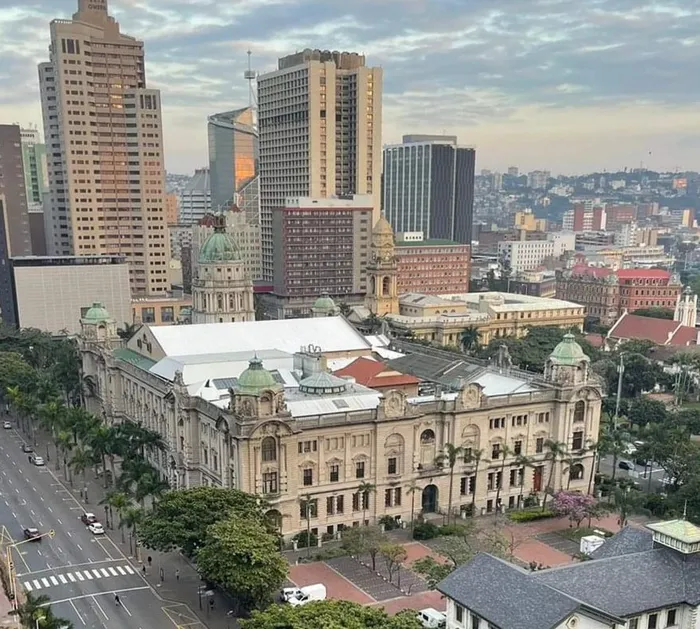
An aerial view of the City Hall building. The City Hall precinct in Durban. A report has shown that millions of rand were spent irregularly on the Revenue Management System. File Picture: eThekwini Municipality.
Durban - Hundreds of millions of rand spent on the eThekwini Municipality’s billing system, the Revenue Management System (RMS), have been flagged as funds that were spent irregularly and in violation of council regulations.
A report tabled before the Municipal Public Accounts Committee (Mpac) last week states that between R300 million and R800m had been spent on the programme irregularly. The report, looking into the regularisation of irregular, fruitless and wasteful expenditure, was tabled during an in-committee (confidential) meeting.
About R86m of this is considered to have been squandered or fruitless and wasteful expenditure – as there was no value for money.
The Mercury understands that the opinions in the committee were split on the way forward. The committee is going to meet again tomorrow and on Wednesday for further engagements.
Some members of the committee were opposed to writing off the entire amount and wanted a portion of it to be recovered. However, some of the officials who were behind the approval process for the RMS contract have since left the municipality. Beyond the attempt to recover the money, some councillors who were part of the meeting said they would consider laying criminal charges against the officials involved.
‘The Mercury’ reported recently that the billing system, which was installed at a cost of more than R1 billion, was facing the chop as it was not compatible with some of the “financial control tools” that are to be implemented by the City.
Councillors were told during a recent briefing that the RMS system was not compatible with the Municipal Regulations on Standard Chart of Account (mSCOA) necessitating the change.
The mSCOA project has been spearheaded by the National Treasury with the aim of improving financial reporting across local governments. It was initiated to address concerns around inconsistencies in local government financial processes, irregular reporting, and poor data integration.
Describing the irregularity, the report before Mpac said processes were not properly followed in appointing the company to develop and implement the RMS system. The report also found that procurement processes were not adequately followed.
Mpac chairperson Thami Xuma said they would seek guidance from the council on how to handle the matter.
“There is the money that was deemed as irregular expenditure, and there is another R86m that has been deemed fruitless and wasteful expenditure. This matter has been an issue for some time and all the other Mpac chairs were not willing to address it,” he said.
Xuma said the reports from the investigative unit that looked into the matter had initially pegged the irregular expenditure at R800m.
“They unpacked that because RMS was still a functioning system, so the money was not lost, the figure dropped to about R300 million.”
IFP councillor Jane Naidoo confirmed the discussions but declined to elaborate, saying the matter was dealt with in-committee.
ActionSA’s Alan Beesley said that while he could not comment on in-committee discussions, the party was concerned that discussions on the unauthorised, irregular, fruitless and wasteful (UIFW) expenditure pertaining to eThekwini’s RMS were classified as “in-committee”.
“The public has a right to know what is going on within the municipality, but classifying discussions as ‘in-committee’ prevents this from happening. It is common knowledge that the RMS has been a dismal failure and has cost the municipality more than R1bn, with the majority of this expenditure deemed as UIFW.”