

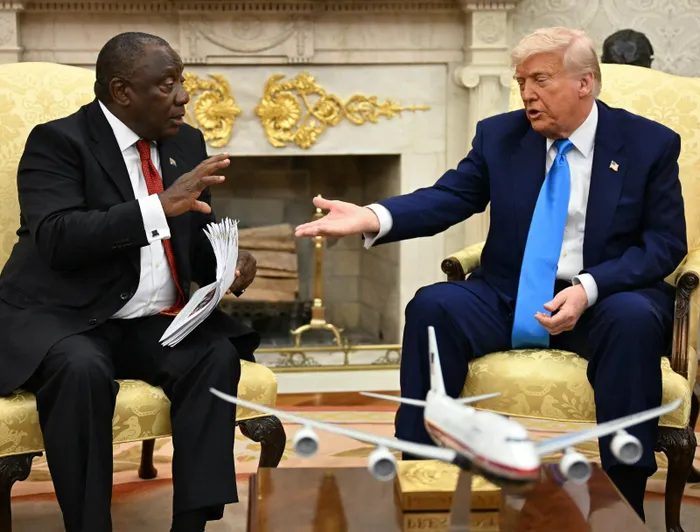
President Cyril Ramaphosa with Donald Trump in the White House.
Image: File
As of mid-January, reports across various media platforms and a statement from the US Embassy suggest that Minister of International Relations and Cooperation Ronald Lamola is carefully weighing whether South Africa should accept the credentials of the newly appointed United States Ambassador-designate, Leo Brent Bozell III.
Bozell has been sworn in by the US Senate in Washington, but he cannot formally begin the duties of his post until President Cyril Ramaphosa accepts his credentials.
This deliberation comes at a time when relations between countries are at a fragile and deeply strained juncture. Diplomatic trust is broken and there are increasing clashes between policy positions.
As the decision hangs in the balance, South Africans are left divided over whether accepting Bozell would stabilise relations or compromise the country’s constitutional and moral foundations.
Dr Thapelo Tselapedi, a lecturer in Politics and International Relations from Rhodes University, argues that the controversy surrounding Bozell is not merely procedural but ideological.
In his view, the ambassador-designate represents a worldview fundamentally misaligned with South Africa’s constitutional order.
"The type of person he is and the foreign policy he represents is going to be incongruent with the politics of South Africa, which at the constitutional point of view is liberal," he said.
Tselapedi warned that Bozell’s long-standing conservative positions, particularly his opposition to affirmative action and social welfare, would shape how he interprets South Africa’s post-apartheid policy framework.
"People like Leo are against affirmative action, he was a big critique of Obama and Obamacare as well and so from a structural point of view, trying to move the conservative lens when looking at the context of SA is going to be problematic."
He cited Black Economic Empowerment and welfare programmes as key examples, arguing that Bozell’s ideological lens would enable him to read South Africa in a vastly different way, one that may find alignment with local right-wing formations that have increasingly mirrored political currents in the United States.
"Leo is an expression of Donald Trump’s view of the world and will naturally represent those views of the world. I don’t see Leo as a person who will stray out of what Donald Trump has said or is doing in the US. And one of the reasons I say this is because what he is doing domestically is also what he is doing at foreign policy level."
Tselapedi placed the current political break down within the broader trajectory of South Africa’s foreign policy since the Zuma administration, which he argues has increasingly operated outside US strategic and security interests since then.
He noted that Bozell, during engagements and interviews around his candidacy, "generally shares the same views as Trump on issues against problematic foreign policy especially with regard to our ICJ case against Israel," adding that Washington has long been uncomfortable with South Africa’s relationships with states such as Iran.
"Our close association with seemingly rogue states like Iran, which are rogue to the extent that they do not operate with the ethical and moral universe that is expected of them by the West, can be perceived wrongly."
While President Ramaphosa is not legally compelled to accept Bozell’s credentials, Tselapedi cautioned that South Africa’s status as a middle power constrains how assertively it can exercise this discretion.
"Ramaphosa would have to be a lot more circumspect about how he exercises the right as a middle power. We cannot easily exercise that right in the same way as a hegemon such as the United States."
Drawing parallels with Washington’s rejection of former South African ambassador Ebrahim Rasool, Tselapedi argued that precedent supports South Africa’s right to refuse.
Dr Ayabulela Dlakavu, an International Relations lecturer, echoed these concerns, warning that accepting Bozell could embolden both foreign and domestic extremist agendas.
"Rasool was rejected on the basis that his views were anti-thetical to USA’s foreign policy position as an enduring and unequivocal supporter of the State of Israel in the Middle East. And so, on US national interest grounds, the USA was justified to reject him," said Dlakavu.
He continued: "The same should be true of Bozell, he is an ambassador-designate whose values are against South Africa’s constitutionally defined identity as a multiracial, diverse nation that belongs to all its peoples regardless of race, class, culture, and all other social constructs of identity. Why would a legitimate president endorse the deployment of a hostile ambassador-designate in Bozell, who is clearly against everything post-1994 South Africa stands for?"
Dlakavu added that his (Bozell) appointment is in line with Trump’s deliberate appointment and deployment of individuals who peddle a narrative and vision of a white civilisation whose interests come first.
Dlakavu highlighted the implications of the Vienna Convention on Diplomatic Relations of 1961, which grants ambassadors extensive privileges and immunities, including protection from arrest and the inviolability of embassy premises.
"In the case of a recently highly hostile US government to Pretoria, it is not wise to accept Bozell given the unmitigated power and privileges he would have in South Africa."
He warned that these protections could intersect dangerously with domestic instability.
"Especially in an environment of far right conservative groups who either want to separate from South Africa through the assistance of supportive foreign powers like the USA… The alternative is therefore a violent secession."
Dlakavu further argued that South Africa’s mineral wealth and strategic resources amplify the risks.
"South Africa’s foreign and domestic policy differences with the USA are definitely a major political and existential risk for South Africa. Logically, South Africa is best served when Bozell’s ambassador credentials are rejected by the receiving president, President Ramaphosa."
Despite these warnings, some analysts argue that South Africa’s diplomatic posture must be guided by strategic realism rather than ideological confrontation. There is broad agreement that South Africa’s approach should be anchored in pragmatism, balancing constitutional principle with economic realities.
Siseko Maposa, director of Surgetower Associates Management Consultancy, offered a differing perspective, arguing that acceptance may be the least destabilising option.
"My view is that in effort to improve diplomatic relations, which have become ever so fraught between the two states, SA must accept unconditionally."
He added that South Africa’s senior diplomats would then need to act decisively.
"SA's senior diplomats must immediately establish credible incentives for increased cooperation between the two states. Economic diplomacy will be key, but also, willingness to tackle some of the more pressing issues, such as SA's gradual ideological drift away from non-alignment, which the US has raised as major concerns."
The cost of rejection, Maposa, warned, could be substantial.
The Presidency and the Department of International Relations and Cooperation did not respond to requests for comment by the time of publication.
lilita.gcwabe@inl.co.za