

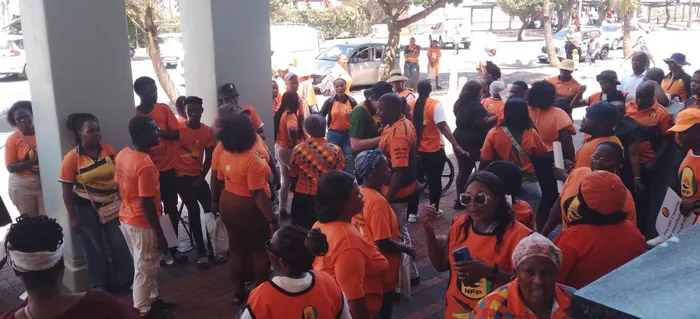
National Freedom Party supporters protested outside the Edward Hotel in Durban, where provincial chairperson and KwaZulu-Natal Social Development MEC Mbali Shinga was undergoing an internal disciplinary hearing.
Image: Willem Phungula
The uMkhonto weSizwe Party (MKP) has not given up on leading the KwaZulu-Natal Government of Provincial Unity (GPU) as it teeters on the brink of collapse due to the National Freedom Party’s (NFP’s) internal divisions.
MKP KwaZulu-Natal convenor Willies Mchunu on Saturday said the party’s intention is to consistently seek ways and means to lead the KwaZulu-Natal provincial government as per the wishes of the electorate, who gave the organisation 45% of the vote in the last provincial elections.
“For the purposes of governing, when given an opportunity, it stands to reason that other parties will be consulted on the configuration of government,” he said.
The troubled NFP is due to meet the other parties in the existing GPU – the IFP, ANC, and DA this weekend.
The PAC has also announced that it will be withdrawing from working arrangements with the ANC starting in Gauteng, which will commence at the Sedibeng District Municipality followed by the Emfuleni Local Municipality.
Thereafter, it will withdraw from all Gauteng municipalities.
“The PAC is also considering its strategic options nationally in line with the interests of our people, accountable governance, and principled politics,” the party said.
PAC President Mzwanele Nyhontso currently serves as Land Reform and Rural Development minister in the Government of National Unity, while one of its councilors, Tebogo Nkonkou, is Community Development MMC in the City of Johannesburg.
The NFP’s divisions over whether to remain in the GPU in KwaZulu-Natal could be costly at the municipal elections expected to take place later this year.
This is according to political analyst Prof. Bheki Mngomezulu, who is the director of the Centre for the Advancement of Non-Racialism and Democracy at the Nelson Mandela University.
“There is a direct link with what is happening now at the provincial legislature and the anticipated local government elections because if they are working together at local government level and they disagree at the provincial level, then of course that will have an impact come November 2026,” he said.
Mngomezulu said while the NFP is the kingmaker, its problem was that it has its own internal challenges.
“There are too many divisions. The internal divisions make things difficult for the NFP because if the NFP was united and they decide to take their one seat to the uMkhonto weSizwe Party (MKP) and the EFF, which have 37 and two, respectively, which would then give the parties 40 out of 80 seats in the provincial legislature,” he added.
According to Mngomezulu, this would then leave the IFP, ANC, and DA with 40. The IFP has 15 seats, the ANC has 14, and the DA has 11.
“However, the scales would be tilted in favour of the MKP because under normal circumstances, the speaker of the National Assembly, and in this case the speaker of the provincial legislature, does not vote until there is need for her deciding vote,” he explained.
Mngomezulu added that there was a misreading of the political situation in KwaZulu-Natal by politicians.
“The initial agreement was at a national level, and then the mistake that happened was that whatever was agreed to at a national level was then pushed down to the province in which case the IFP produced the premier even though it received 18% of the votes in KwaZulu-Natal,” he further stated.
Mngomezulu believes the expectation from the NFP then was that if it supported the IFP, DA, and ANC, it was going to be given the mayorship of the Zululand District Municipality.
The NFP was hoping to get the seat vacated by Rev. Thulasizwe Buthelezi, who was appointed a member of the provincial Cabinet, according to Mngomezulu.
“Unfortunately, that was never part of the agreement, so basically the NFP had its own reading of the situation that it was a given that we would get Zululand. The IFP on the other hand is saying that we never had any deal at the local government level,” he said.
In addition, Mngomezulu said the DA made the wrong pronouncement by stating that under no circumstances should the MKP be allowed to run KwaZulu-Natal despite the fact that they got the highest number of votes.
“At the national level, the ANC got only 40.18% but it produced the president and the deputy, then in KwaZulu-Natal, the MKP got 45.35% and yet it did not produce the premier and it was into the opposition benches, which is in a way a disservice to the people of KwaZulu-Natal, who are the ones who voted for these parties in the first place,” he said.
Zakhele Ndlovu, a political analyst at the University of KwaZulu-Natal, said it appears that the divisions within the NFP could save the GPU.
“One faction wants to stay in the GPU and another wants to withdraw. So I don't think the collapse of the GPU is imminent,” he stated.
Ndlovu said the faction loyal to Social Development MEC Mbali Shinga, who is the NFP sole member of the legislature, wants to take the matter to court.
“I see this thing dragging on for a long time. The chances of a MKP-led coalition are very slim at this point. There is also a possibility that the NFP wants to have it both ways so that it keeps getting the publicity it desperately needs as the local government elections approach,” he explained.
Ndlovu also believes Shinga's position as MEC is good for the NFP as it could divert funds for the election campaign.
He suggested that NFP President Ivan Barnes is also playing former president Jacob Zuma to get the sympathy of the MKP voters and that there may be many factors at play in the saga.
NFP National Chairperson Sibusiso Mkhabela did not respond to requests for comment on Saturday, but earlier this week indicated that Barnes had no constitutional authority to enter KwaZulu-Natal and impose decisions that fall within the mandate of the provincial caucus and the party’s provincial executive committee.
loyiso.sidimba@inl.co.za