

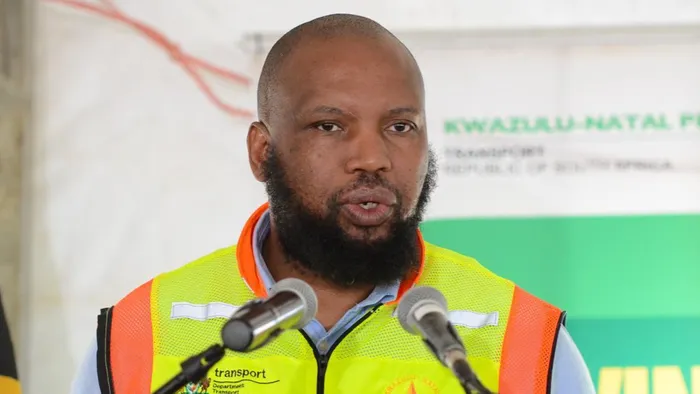
KZN MEC for Transport Siboniso Duma said the department is working on strengthening legislation governing the taxi and scholar transport industry, with clear provisions for driver vetting, vehicle standards, and operational oversight.
Image: Supplied
In the wake of a devastating scholar transport crash, President Cyril Ramaphosa has tasked the Minister of Basic Education, Siviwe Gwarube, the Minister of Transport, Barbara Creecy, and other relevant stakeholders to look into ways of preventing further loss of life.
This comes as the KwaZulu-Natal Department of Transport moves swiftly to strengthen legislation governing scholar transport in an effort to curb accidents that have claimed the lives of pupils. The legislation will be enhanced to ensure, among other conditions, driver vetting and vehicle standards.
Scholar transport is in the spotlight after another accident in Gauteng claimed the lives of 12 learners on their way to school. It is suspected that the vehicle had been overloaded at the time. Last year, three pupils died while on their way to school when the brakes of their transport failed, and the vehicle crashed into a barrier.
Ramaphosa was speaking during his keynote address at the three-day 2026 Basic Education Sector Lekgotla, held at the Birchwood Hotel in Boksburg yesterday.
“We need to act now, and we need to act together to ensure that scholar transport is safe and reliable, and accept that young lives are put at risk as they seek the growth and enrichment that education provides,” he urged.
In KZN, the Department of Transport stated that work is underway to ensure that pupils are safe on their way to and from school. MEC Siboniso Duma said it is important to distinguish between the transport provided by the department to learners travelling to school and scholar transport being provided by private operators.
“There is scholar transport provided by the Department of Transport, working with the Department of Education. We provide scholar transport to learners who are expected to walk more than three kilometres to school. In terms of scholar transport provided by the government, we do not have reports of accidents. The challenge lies with private scholar transport. We are encouraging SANTACO's Scholar Transport to continue with their inspections and to ensure compliance among their members,” he said.
He said the Public Transport Enforcement Unit — Operation Shanela and Road Traffic Inspection is continuing with inspections, spot checks, and roadblocks of scholar transport.
He said they are also developing a final framework aimed at strengthening partnerships with the private sector, especially with entities such as the Vehicle Testing Association (VTA).
Last year, they had agreed to work together to identify those operating vehicles without roadworthy certificates and ensure that those issuing fraudulent certificates are arrested. He said efforts to protect learners will also include:
Duma said learners are the future of the country.
“The acquisition of knowledge necessary to grow all sectors of the economy is only possible if we enable learners to attend school. This is why we assisted the Department of Education by funding scholar transport.”
Sifiso Shangase of SANTACO in KZN said they have strict protocols to ensure that the children are safe.
“We have the enforcement unit called Hlokomela that ensures safety; that unit is also working to ensure that scholars are safe and the vehicles they are being transported in are safe.”
He said they are identifying training opportunities for scholar transport operators including first aid care, the development of partnerships with schools where the learners are being taken, and partnerships with police to ensure that they work together in protecting the pupils.
For more articles from The Mercury, click the link THE MERCURY