

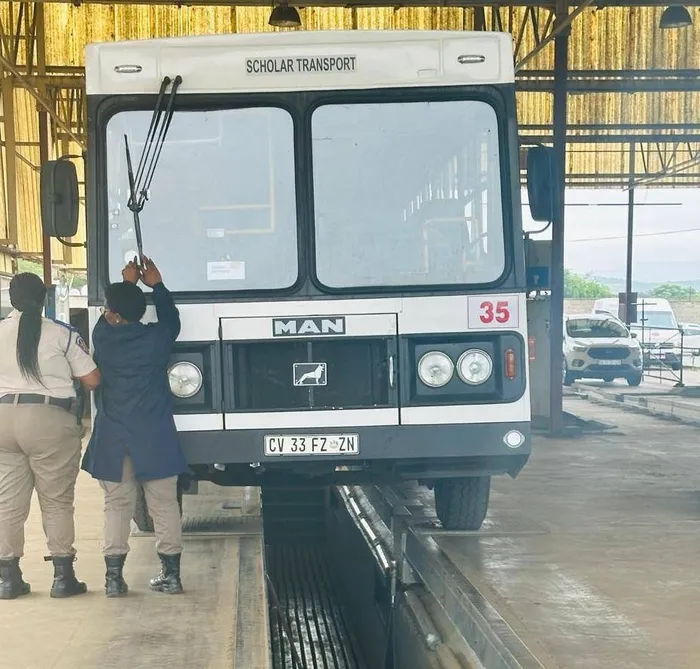
A scholar transport bus is inspected by Road Traffic Inspectorate officials in KwaZulu-Natal.
Image: KZN Department of Transport
In the aftermath of a scholar transport crash in Vanderbijlpark that claimed 14 lives, the Department of Transport has called on parents to play a more decisive role in preventing further tragedies, warning that many learner transport risks are avoidable if basic safety rules are enforced.
Fourteen pupils died in a crash in Vanderbijlpark in the Vaal, which took place on Monday. The scholar transport minibus they were travelling in veered onto the oncoming lane and crashed into a tipper truck. The minibus driver Ayanda Dludla is facing charges of murder.
In guidance issued following the accident, the Department said that choosing safe scholar transport is a shared responsibility, stressing that parents have a central role in ensuring that children are not exposed to illegal or unsafe transport.
“Parents play a critical role in protecting learners by insisting on legality, safety, and accountability,” the Department said, adding that parents should only make use of registered and permitted scholar transport operators.
The Department urged parents to verify operating licences through the Provincial Regulator Entity and to ensure that passenger liability insurance is in place. It warned that overloading remains one of the most dangerous practices in learner transport, as it compromises a vehicle’s braking ability and overall stability in emergencies.
Parents were also reminded to avoid unroadworthy and unregistered vehicles by checking that roadworthiness certificates and licence discs are valid and up to date. According to the Department, these must be renewed annually for minibus taxis and every two years for buses.
“Unroadworthy vehicles can often be identified through visual inspection,” the Department said, pointing to hazards such as structural damage, worn tyres, cracked windscreens that limit driver visibility, broken wipers, loose interior fittings, and faulty doors.
The Department said parents should not feel pressured into accepting unsafe transport arrangements, emphasising that “parents must not be afraid to refuse transport that does not comply with basic safety standards,” even if it means seeking alternative transport options.
Driver compliance was highlighted as another critical safety factor. The Department said parents must ensure that drivers hold a valid driving licence endorsed with a Professional Driving Permit for passenger transport, noting that permit holders must be 21 years or older and fit to drive.
“Parents should make sure that the driver is not intoxicated and is not showing signs of fatigue or distress,” the Department said, adding that scholar transport drivers are expected to obey traffic laws and speed limits at all times.
Parents were encouraged to teach learners to observe driver behaviour and to report conduct that places them in danger. Any concerns, the Department said, should be reported to schools or relevant authorities so that corrective action can be taken.
The Department also stressed the importance of seatbelt use, saying parents must ensure that vehicles have functional seatbelts and that learners use them at all times.
“It is the responsibility of parents to ensure that children are seated properly and do not stand or hang out of vehicles,” the Department said.
Safe pick-up and drop-off points at home and at school were also emphasised, with parents urged to assist learners and ensure that children wait for transport away from roadways. Learners should also be taught to behave responsibly inside vehicles and avoid distracting drivers.
Against this backdrop, the Democratic Alliance in KwaZulu-Natal has warned that learner transport safety failures reflect a broader systemic crisis.
DA KZN transport spokesperson Riona Gokool said the party was calling for stricter enforcement and oversight, including ongoing, unannounced inspections by the provincial Department of Transport.
“Reactive measures taken after near-misses or fatalities are not enough,” Gokool said, pointing to the recent Gauteng crash as well as a fatal learner transport incident in Imbali last year.
She said information presented to the KZN Transport Portfolio Committee showed that inspections of learner transport vehicles were often periodic rather than continuous, while policy disputes and budget constraints continued to undermine safety.
Gokool also raised concern about previous admissions by the provincial Department of Education regarding learner overloading, warning that such practices dismantle safety safeguards designed to prevent serious injuries and deaths.
The DA said more than 157,000 learners in KZN remain on waiting lists for the Learner Transport Programme, forcing many children to walk long distances or rely on unsafe informal transport.
“Our children’s lives cannot be balanced against budgets, bureaucracy, or policy stubbornness,” Gokool said, adding that learner safety must remain a non-negotiable priority.
For more stories from The Mercury, click the link THE MERCURY