

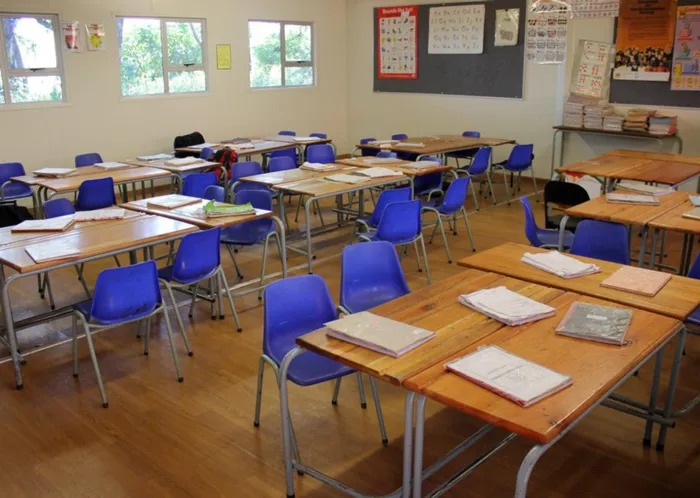
Prioritising psychosocial wellbeing can significantly reduce school dropout rates, a new report states.
Image: Independent Newspapers Archives
South Africa’s efforts to reduce school dropout will fail unless psychosocial wellbeing is treated as a core pillar of the education system rather than a peripheral add-on, according to a new report by the Zero Dropout Campaign.
Despite record-breaking improvements in matric pass rates in recent years, the country continues to lose a significant proportion of learners along the way.
It is still estimated that up to four in ten learners who start school in Grade 1 will exit the system before completing Grade 12, cutting hundreds of thousands of young people off each year from further education, skills development, and meaningful employment.
The campaign’s latest report, School Dropout: Hanging by a Thread, argues that dropping out is rarely a sudden or purely individual choice.
Drawing on national research, global evidence, and implementation experience, the report shows that learners typically disengage after years of accumulating psychosocial strain. Poverty, violence, bullying, hunger, poor mental health, weak social support, and unsafe school environments combine over time, with risks intensifying during key transition points, particularly adolescence.
According to UNICEF, 73% of young people in South Africa require mental health support. Yet psychosocial support (PSS) has historically not been treated as an organising principle of dropout prevention. The report defines PSS as encompassing mental health, social connectedness, resilience, and supportive environments, the very conditions that help learners remain engaged in school.
“Adolescence is both a period of heightened risk and a ‘second window of opportunity,’ when the right support can still reverse earlier adversity, so strengthening mental health and other support is thus essential to safeguarding overall psychosocial wellbeing,” said Zero Dropout Campaign Programme Director Merle Mansfield.
While there has been growing interest and investment in Early Childhood Development, the report cautions that these gains will not deliver the long-term impact anticipated if support drops off after the foundational years. Dropout accelerates sharply after Grade 9. Of the approximately 1.2 million learners who enter Grade 1 each year, only about 800,000 ultimately complete matric.
This reality was publicly acknowledged earlier this month during the announcement of the national 2025 matric results, when the Minister of Basic Education, and her Director-General, confirmed the scale of post-Grade 9 attrition. Their stated commitment to prioritising psychosocial support in 2026 is therefore “encouraging and timely,” the report notes, given the high prevalence of poor mental health among adolescents and the strong link between exposure to violence, bullying, hunger, and substance use and school disengagement.
South Africa already has several progressive policy frameworks in place, including the Integrated School Health Policy, the National Mental Health Policy Framework (2023–2030), and the Safe Schools Protocol. However, Hanging by a Thread highlights persistent gaps between policy intent and everyday realities in schools.
Learners who lack a trusted adult or a sense of belonging at school are particularly vulnerable. Teachers often become the first line of psychosocial support, but most are given little training, time, or professional backing to fulfil this role.
Access to specialist services remains severely constrained. Estimates suggest there is only one social worker for every 23,000 learners in South Africa, resulting in referral delays of weeks or even months. During this time, learners frequently disengage from school or drop out altogether.
Research by the Zero Dropout Campaign also emphasises that schools do not operate in isolation. “They operate within fragile community ecosystems often shaped by unemployment, service delivery failures, and inequality. It is unrealistic to expect schools to compensate for these pressures without adequate psychosocial infrastructure,” Mansfield said.
Using case studies from across the country, the report shows that dropout can be prevented when psychosocial support is embedded into everyday school life rather than introduced only during crises.
Effective approaches include on-site psychosocial services and trusted adult “anchors,” child and youth care workers embedded in schools, trauma-informed and sport-based programmes, peer support and mentorship, low-stigma digital tools, targeted interventions during the Grade 9–10 transition, and safeguards against informal “push-out” practices.
Crucially, the report stresses that the quality of support matters more than its mere existence. Trust, empathy, confidentiality, and consistency are identified as decisive factors in whether learners remain engaged.
The Zero Dropout Campaign is calling for dropout prevention and psychosocial wellbeing to be recognised as a whole-of-society responsibility, requiring coordinated action across government departments, schools, communities, civil society, and the private sector.
“To halve South Africa’s dropout rate and reach the National Development Plan’s (NDP) targets by 2030, we must move beyond seeing dropout as normal or inevitable,” Mansfield said. “When psychosocial wellbeing is prioritised, schools become places where learners don’t just survive but belong, persist, and thrive.”
For more stories from The Mercury, click the link THE MERCURY