

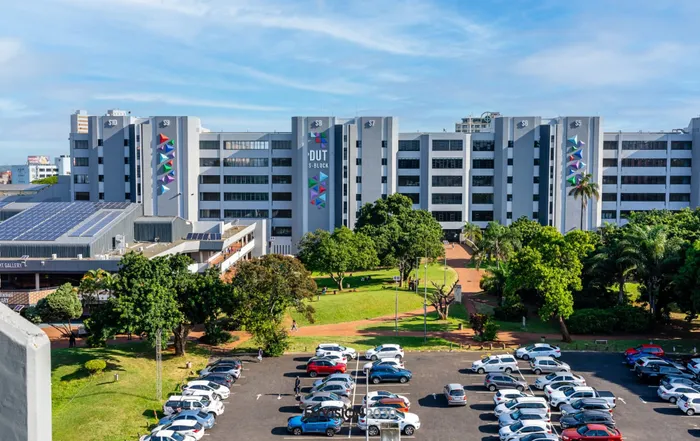
The Durban University of Technology has welcomed 9,416 new students.
Image: Khulasande Tshayile.
The Durban University of Technology's Student Representative Council’s (SRC) Bridge Relief Fund has called for applications as the closing date is tomorrow.
According to the SRC, the fund prioritises students who can demonstrate financial need in line with NSFAS criteria and who achieved at least a 60% academic average in their most recent examination sitting. Applicants are required to submit supporting documents, including recent proof of income, certified identification, and a one-page motivation.
It added that students who have previously received assistance will not be prioritised.
Applications close tomorrow, February 4 at 2pm.
Meanwhile DUT announced that 9,416 students were admitted for the 2026 academic year drawn from more than 231,503 applicants.
DUT held its Orientation and Parents’ Day, held on 3 and 4 February 2026, where Vice-Chancellor and Principal Professor Thandwa Mthembu addressed students, families, staff, and stakeholders on the realities of university life.
Addressing first-year students, Mthembu acknowledged the competitiveness of admission, telling them: “Out of 231,503 applicants, you were selected as one of the 9,416. You are exceptional. You are the cream of the crop.”
He said entering university marked a defining moment that would shape both students’ careers and their contributions to society.
Mthembu stressed that academic success depends on “shared purpose” and “shared responsibility and accountability,” warning that the progress achieved by the institution over the past two decades should not be taken lightly. “Protect what has been built. Act in ways that strengthen it,” he said.
He also addressed the visible construction and disruption across DUT campuses, describing it as necessary but temporary. “What you are witnessing is investment in the future,” he said, referring to upgraded infrastructure, learning spaces, and student residences.
Mental health emerged as a key concern in his address. “There is a growing and serious concern regarding mental health among students in higher education,” Mthembu said, noting that academic pressure, financial stress, and social adjustment often contribute to anxiety and depression. He urged students to make use of available support services.
On student conduct, he cautioned against careless use of social media. “What you post, share, comment on, and amplify does not disappear,” he said, adding that digital behaviour can affect future academic and employment opportunities. While affirming freedom of expression, he stressed that it must be exercised responsibly.
First-year student Khumalo Mnikelo from Kwahlabisa, who is studying for a Bachelor in Child and Youth Care, said admission followed years of uncertainty.
“We’ve been waiting for this for almost two or three years, and I’m grateful that I can finally study and make my dreams come true,” he said.
Vuyisile Mkhize from Umkhomazi, enrolled for a Diploma in Public Management, said joining DUT marked a new chapter.
“I am very happy to be part of DUT. Now I will be studying and life will carry on,” he said.
To apply for the DUT (SRC) Bridge Relief Fund, click on the links below:
Midlands: https://forms.office.com/r/UWQz1n80h8
Durban: https://forms.office.com/r/6LLm14eA04
For more stories from The Mercury, click the link THE MERCURY