

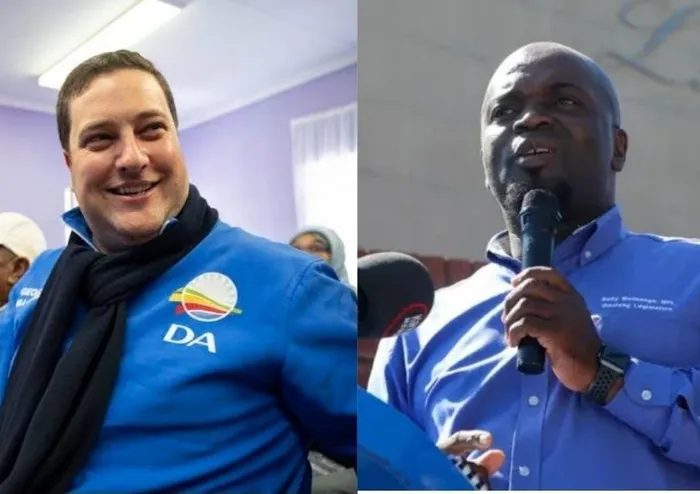
Cape Town Mayor Geordin Hill-Lewis and DA Gauteng Provincial Leader Solly Msimanga have emerged as frontrunners in the DA leadership race.
Image: Armand Hough and Timothy Bernard / Independent Newspapers
With reports indicating that DA federal leader John Steenhuisen will not contest the party’s leadership race in April, attention has shifted to who could emerge as his successor.
Steenhuisen is expected to address a press briefing in Durban today, with reports suggesting that he will not seek re-election at the party’s federal congress in April.
As South Africa heads into a critical local government election year, the DA is under pressure to present a leader who can broaden its appeal beyond its traditional base. Party members in KwaZulu-Natal, who declined to be named for fear of reprisals, expressed surprise at the move by Steenhuisen.
One leader said, “This is news to me; it sounds like a rumour.” Another member said they were aware of the decision but declined to speak any further on the matter.
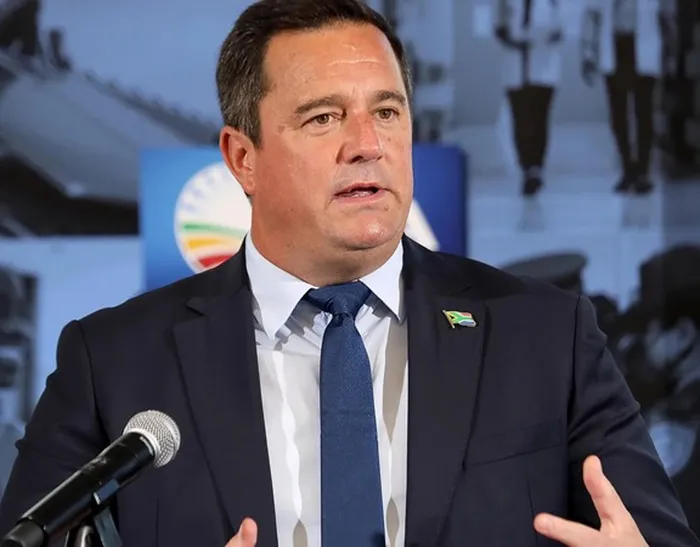
DA leader John Steenhuisen may not seek re-election at the party's federal congress in April.
Image: File
Yet another DA member, speaking on condition of anonymity, said the party was in need of fresh blood and direction.
“John led the party well out of the 2019 slump as an opposition leader. He was right for that time. Our next leader must be strong enough to stand up to the GNU partners so that there is still a strong opposition and DA values are not lost.”
Another party leader said the developments were shocking but welcomed. “Party leaders come and go, and they must make a decision from the offices they occupy. If the leader believes that he or she has reached the limit of their contribution, it is good for them to step aside, or we run the risk of having a leader in office who is 90 years old and cannot even lift a finger.”
Another DA leader said: “This (not contesting) is contrary to what we knew was going to happen, as we had believed he was a shoo-in for the post, but the other side of the coin is that if he is indeed not contesting, it is not surprising as we knew that he did not have support in Gauteng or the Western Cape, so re-election would have been very difficult for him.”
Political analysts say the leadership contest will test whether the party can position itself as a credible alternative government rather than a permanent opposition. At this stage, two names are emerging as likely frontrunners: Gauteng opposition leader Solly Msimanga and Cape Town Mayor Geordin Hill-Lewis.
Party members confirmed to The Mercury that Msimanga and Hill-Lewis had been mentioned but said “the field is open”.
Other figures being mentioned include Western Cape Premier Alan Winde and Communications and Digital Technologies Minister Solly Malatsi.
However, analysts suggest that Steenhuisen’s decision not to run has fundamentally reshaped the race.
Political analyst Professor Bheki Mngomezulu said Steenhuisen’s withdrawal has “opened a Pandora’s box”, despite assurances from DA federal council chairperson Helen Zille that the party will not fracture during the succession process. “There was no clear indication that Steenhuisen would pull out of the race,” Mngomezulu said.
“His withdrawal creates space for almost anyone to emerge. It could even open the door for someone like Solly Msimanga.”
Mngomezulu cautioned, however, that the final outcome may hinge on uncomfortable realities around race and internal party dynamics. “The DA always says race and gender do not matter, but that is theory,” he said.
“If it comes down to a straight contest between Geordin Hill-Lewis and Solly Msimanga, then Msimanga will struggle.”
Political analyst Daniel Silke said while Steenhuisen had some successes, his overall legacy would be one of stagnation in terms of the party’s growth and missed opportunities.
“He brought stability to the DA but not electoral growth. The big deficiency of the Steenhuisen years is that while the party managed this awkward positioning within the GNU and (is) still in an awkward dance with the ANC, the DA has not shown growth; in fact, it is under pressure from smaller parties. He did not have the charisma to reach out to every diverse constituency that really should be reeled in for the DA going forward,” said Silke.
Another analyst, Professor Kedibone Phago, said Steenhuisen’s exit may be linked to mounting internal pressure following his public fallout with former DA MP Dion George, who resigned from the party after accusing its leadership of lacking transparency and honesty.
George claimed internal processes were opaque and that raising concerns came at personal cost. Zille rejected these claims, accusing George of bringing the party into disrepute and noting that he had resigned before answering to a pending disciplinary process.
“It is unfortunate that Dr George resigned before accounting to the DA’s Federal Legal Commission,” Zille said. “There are allegations relating to irregular staff appointments, the misuse of departmental information for internal party matters, and damaging the party through the media.” Behind the scenes, relations between Steenhuisen and George had deteriorated sharply. Their disagreements centred on strategy, communication, and the DA’s role in the Government of National Unity (GNU).
George accused Steenhuisen of misusing a party-issued credit card for personal expenses, including hotel stays, car rentals, and household purchases. However, the party said Steenhuisen had been cleared of any wrongdoing in an internal investigation.
For more stories from The Mercury, click the link THE MERCURY