

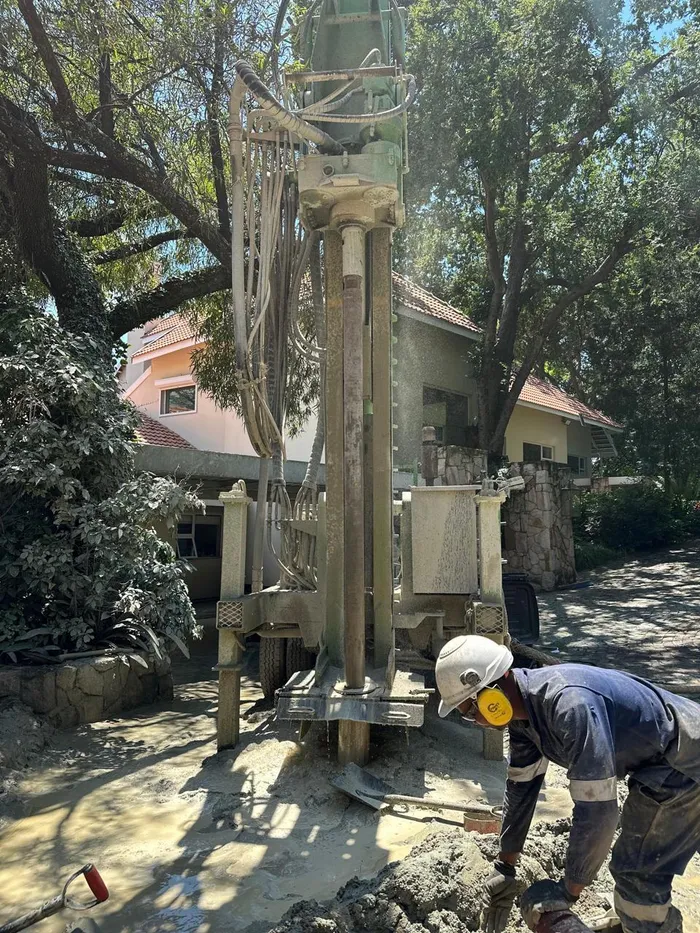
Equipment to drill a borehole. The Department of Water and Sanitation is proposing new regulations to have stricter control over borehole drilling in the country.
Image: Supplied
The Department of Water and Sanitation is looking to exert tighter control on the country's water sources to ensure they are not overused.
Last month, it published draft regulations aimed at regulating the drilling of boreholes in an effort to keep track of this activity. The proposed regulations, which are available on the department's website, are currently out for public comment.
The department has existing control measures in place to monitor the drilling of boreholes for commercial use and requires those users to register, while domestic users are not affected. However, the proposed regulations would require all existing borehole owners and those seeking to drill boreholes to register with the department.
The move comes as communities, frustrated by their local councils' failure to deliver water, are having to contract service providers to drill boreholes and pipe the water to their homes. This has been the case for homes in the Vulindlela area, in the Msunduzi Municipality, where the council has failed to deliver water for several years.
The draft regulations propose that all borehole owners, including Schedule 1, Existing Lawful Use (ELU), General Authorisation (GA), and water use licence users, must capture their details and the existing geosite information on the National Groundwater Archive (NGA).
Regarding new boreholes, geosite identifiers must be obtained from the NGA before undertaking the drilling of a borehole on any aquifer, the draft regulations document states.
“The water user or driller of the geosite must capture and provide, at minimum, the drilling data on the NGA, in line with the Standard Descriptors for Geosites (SDG), and within two months after the closure of the registered project on the Geosite Identification Allocator Tool (GIAT).”
It stated that any person intending to install borehole pumping equipment for the purpose of abstracting water from an aquifer must provide yield test results or recommended sustainable abstraction rates, together with the pump installation settings on the NGA before the commencement of water abstraction.
The draft regulations state that the drilling of boreholes for any water use, including domestic, mining, industrial, livestock, and irrigation purposes, is prohibited within 50 m of cemeteries and informal waste disposal sites, among others.
Speaking on the need for such action, the department stated that it is the custodian of South Africa’s water resources and is mandated to manage, protect, develop, conserve, and control the country's water resources.
“Without proper monitoring, groundwater reserves could potentially become depleted, leading to deterioration of water quality, environmental degradation, and reduced water security.”
The proposed regulations aim to improve data and information management through the registration of geosites (boreholes) for all existing and new groundwater users, and the systematic capturing of borehole drilling, geosites (boreholes), and geohydrological information and reports.
The new proposed regulations require that everyone who wants to drill a borehole must register their borehole and receive a borehole number from the Department, indicating the location, quality, quantity, and impact of the abstraction before a borehole can be drilled.
“As South Africa continues to face water scarcity challenges, strengthening groundwater regulations and promoting borehole registration through the National Groundwater Archive (NGA)—a groundwater information management system—are essential steps toward sustainable management. By understanding how much groundwater is being extracted, where, and by whom, authorities and users alike can work together to protect and preserve one of South Africa’s most vital reservoirs,” it said.
The document also warned of enforcement action if the regulations are not followed.
“Any person who is guilty of an offence is liable, on the first conviction, to a fine or imprisonment for a period not exceeding five years, or to both a fine and such imprisonment; and, in the case of a second or subsequent conviction, to a fine or imprisonment for a period not exceeding ten years or to both a fine and such imprisonment.”
Ish Prahladh, of the eThekwini Ratepayers and Residents Association, said the action was ridiculous.
“This is a ridiculous idea when the municipality cannot keep up with their promises to provide a basic right to the ratepayers and residents, and that is the reason ratepayers and residents look for alternatives.
“Look at Phoenix, Verulam, Tongaat, and other areas; if businesses had not helped to put boreholes in schools and special places, then all the communities would have been without water, the basic right.
“The Department of Water and Sanitation needs to put their house in order before they try to do this. We will definitely oppose this,” he said.
Melanie Veness, Pietermaritzburg and Midlands Chamber of Business (PMCB), said, “The drilling of boreholes for commercial use (high-volume extraction) is restricted and regulated for good reason—to protect the water table and preserve water resources.
“We really can’t have everyone drilling boreholes, but businesses can’t operate without water, so it’s a real conundrum.”
For more stories from The Mercury, click the link THE MERCURY