

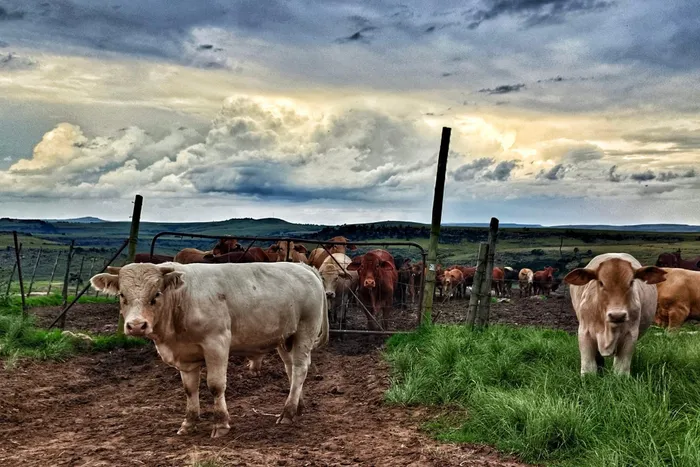
As KwaZulu-Natal faces a devastating foot-and-mouth disease outbreak, the province seeks disaster classification to mitigate economic losses and protect food security.
Image: Murray Swart / Independent Newspapers
KwaZulu-Natal has formally moved to have the escalating foot-and-mouth disease (FMD) outbreak classified as a provincial disaster, as the province grapples with mounting economic losses, food security risks, and growing distress among farmers and rural communities.
Premier Thamsanqa Ntuli delivered the stark warning during a media briefing at the Premier’s Office in Durban on Friday, saying the province is already overwhelmed by the scale of the outbreak.
“We are already in a state of disaster as a province,” Ntuli said.
“The economic consequences have changed. The financial consequences have been severe, including trade restrictions, export limitations, and sustained pressure on both emerging and commercial farmers.”
KwaZulu-Natal is currently the epicentre of the outbreak, with confirmed cases in all districts. Of the 207 outbreaks recorded to date, 187 remain unresolved. The province is home to approximately 2.4 million head of cattle, spanning communal herds, feedlots, commercial beef farms, and dairy operations.
Ntuli said a comprehensive report on the outbreak and the provincial response was submitted to the provincial Cabinet earlier this week. Following Cabinet deliberations, the Provincial Disaster Management Centre submitted a disaster assessment to the National Disaster Management Centre.
“The proposed classification of a state of disaster will provide the province with the necessary framework to reprioritise resources, mobilise national funding, secure speedy access to vaccines directly from suppliers, and strengthen coordinated interventions,” he said.
The Premier warned that the impact of FMD extends far beyond farms. Food security is under strain, while livelihoods linked to agriculture are increasingly at risk.
KZN’s farming sector employs hundreds of thousands of workers who collectively support more than 639,000 dependants.
The dairy industry has been particularly hard hit. “This province is home to 21% of the country’s daily milk producers,” Ntuli said.
“The entire dairy chain is valued at R7 billion, employing approximately 3,120 workers who support 639,000 families.”
He stressed that dairy cattle are more vulnerable to severe losses. “For other cattle, they may show symptoms but not necessarily die. But in the dairy industry, the impact is very severe,” he said, revealing that he had received a call from a dairy farmer shortly before the briefing who described the situation as “very bad” for his family.
Provincial Chief State Veterinarian Dr Themba Sikhakhane sought to reassure farmers that systems are in place to contain the disease. “I can assure you that we have the capability to assist farmers, and we are going to make sure that we use the vaccine within the time allocated,” he said.
Sikhakhane highlighted extensive community outreach efforts. “We communicate with rural areas using social media, we speak to amakhosi, we call community meetings, and I personally visit various communities to make sure that we send the message,” he said.
On the vaccination drive, Sikhakhane confirmed that doses are being sourced through authorised channels, mainly from Botswana, using both provincial and national budgets. With KwaZulu-Natal accounting for about 2.45 million cattle, vaccinations will be rolled out in phases.
“We are hoping to cover the whole province within six months,” he said.
Ntuli concluded with a firm commitment from the provincial government: to curb the spread of FMD and protect jobs, the economy, and food security in KwaZulu-Natal.
For more stories from The Mercury, click the link THE MERCURY