

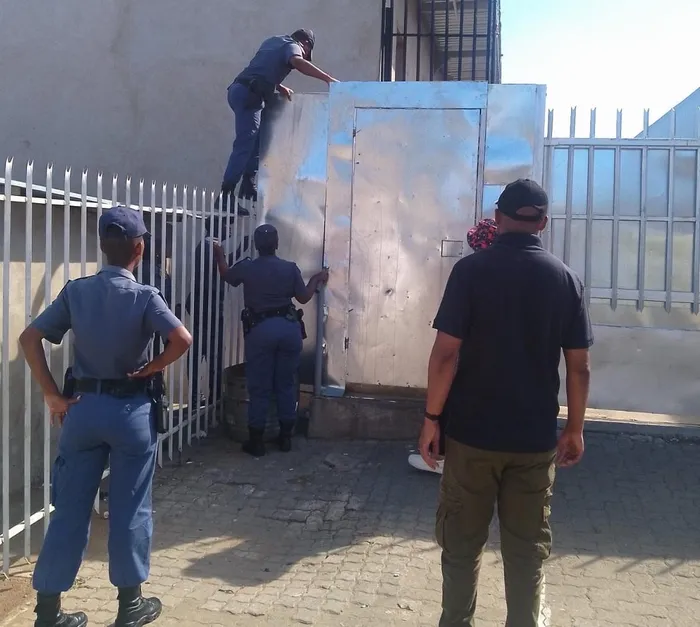
The Department of Employment and Labour, SAPS, Newcastle Metro police and the Department of Home Affairs conducted inspections at Newcastle businesses.
Image: Department of Employment and Labour
A coordinated inspection blitz in Newcastle’s textile and clothing industry in KwaZulu-Natal has uncovered widespread labour and immigration violations, resulting in the arrest of two Chinese employers and the discovery of 34 undocumented foreign workers.
The joint operation was carried out by the Department of Employment and Labour (DEL), the South African Police Service (SAPS), Newcastle Metro Police, and the Department of Home Affairs at the Newcastle Industrial Park.
The inspections were overseen by the Parliamentary Portfolio Committee on Employment and Labour as part of its oversight visit to the Amajuba District this week.
According to a statement from the department, during the blitz inspectors issued a prohibition notice to Qing Xiu Clothing after finding serious breaches of labour and occupational safety laws.
The department said the company failed to ensure safe electrical installations, did not register or produce a steam generator certificate, and was noncompliant with the Unemployment Insurance Act (UI), the Compensation for Occupational Injuries and Diseases (COID), and other violations.
The prohibition notice prevents the company from resuming operations until all identified risks are addressed.
Inspectors also ordered workers who were living in on-site accommodation at the factory to vacate the premises by today, February 6, as the accommodation was described as dangerous, unhygienic, and highly vulnerable to fire hazards.
Department of Employment and Labour provincial chief inspector Mlungisi Zondi said the operation highlighted the need for sustained enforcement.
“There is a need to conduct further sustained intensive inspection blitzes across all sectors in the area,” Zondi said.
In total, six manufacturers were inspected during Thursday’s operation. All six were found noncompliant with the Unemployment Insurance Fund requirements. Four were compliant with the Basic Conditions of Employment Act, while five were noncompliant with Occupational Health and Safety regulations, and five were also noncompliant with COID legislation.
The inspection blitz coincided with an oversight visit by the Parliamentary Portfolio Committee, which also included visits to the Newcastle Labour Centre and inspections across farms, manufacturing, textiles, and retail sectors in the district.
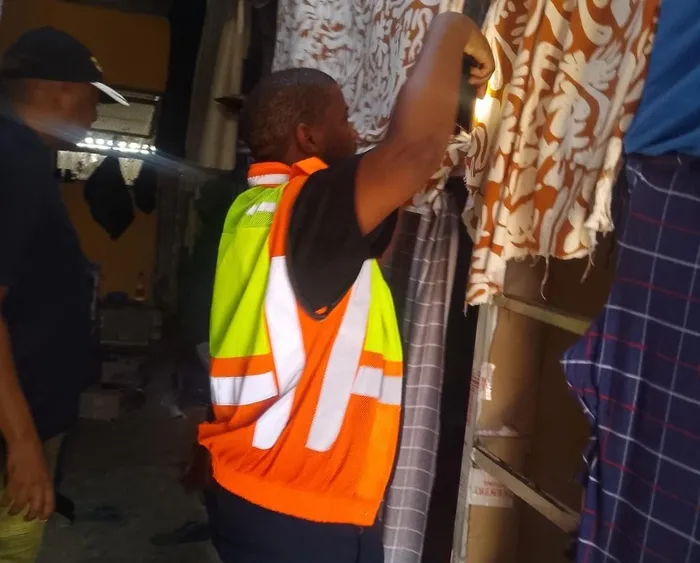
Inspections were carried out at six manufacturing companies.
Image: Department of Employment and Labour
Meanwhile, the Congress of South African Trade Unions (COSATU) in KwaZulu-Natal welcomed the oversight visit by the Parliamentary Portfolio Committee on Employment and Labour to Amajuba District, Newcastle and surrounding areas.
In a statement, COSATU said it had deployed provincial and local leadership to support the delegation, adding that the visit forms part of an ongoing effort to strengthen accountability.
“It responds directly to what we have consistently raised that public representatives must not sit on their laurels while workers suffer silently in workplaces where exploitation and lawlessness continue unchecked,” the federation said.
COSATU warned that some employers may attempt to temporarily comply or remove workers in order to hide violations during the oversight period, stating that “such conduct must be exposed and decisively dealt with.”
The federation urged workers to come forward and report violations, including underpayment, unsafe working conditions, victimisation, and the abuse of foreign nationals.
It also reminded employers that “the National Minimum Wage for 2026 will increase to R30.23 per hour in March this year,” stressing that no worker should earn below the legislated minimum.
Reacting to conditions uncovered during the inspections, COSATU said, “Some of the revelations emerging from the workplaces visited are deeply shocking and confirm the urgency of intensified inspections and stronger enforcement.”
For more stories from The Mercury, click the link THE MERCURY