

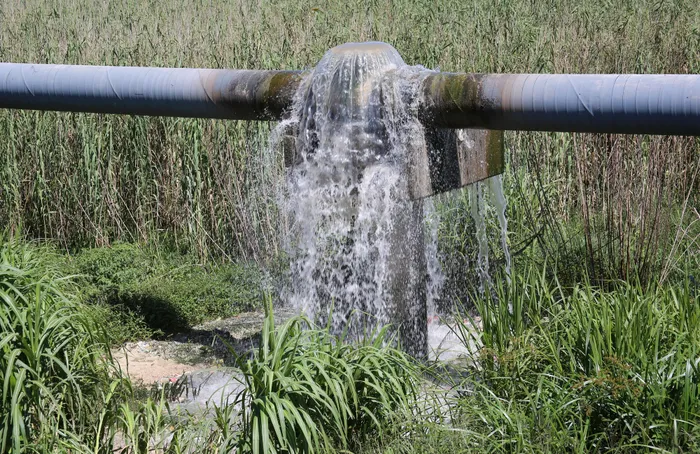
UMngeni-uThukela has appointed a service provider to help detect leaks in the eThekwini Municipality's system amid concerns about the losses and their impact on the municipality.
Image: Tumi Pakkies / Independent Newspapers
The uMngeni-uThukela Water board has stepped in to contain the loss of massive amounts of drinking water in the eThekwini Municipality.
An amount of R50 million is being invested by uMngeni-uThukela to combat water leaks in the City. Recent figures provided by the municipality showed that non-revenue water (NRW), which includes water lost through leaks, was at 52.8%.
UMngeni-uThukela announced during a briefing yesterday that it has appointed a service provider to help detect leaks in the municipality's system amid concerns about the losses and their impact on the municipality.
The water board tabled its annual report yesterday, which revealed that it is in a strong financial position, having performed above the financial expectations it had set for itself.
In the report, it detailed numerous projects that are planned or underway to fulfil its responsibility of ensuring water access to the province. It also addressed various problems it faced, especially the challenge of debt owed by municipalities.
The issue of water losses is a serious concern for the eThekwini Municipality.
In a statement recently, the DA in eThekwini claimed that NRW was much higher than recorded, placing its level at 60.9%. It said this means that more than half of all treated water is lost (through persistent leaks and/or illegal connections), unbilled, or uncollected. This translates into losses of well over R2 billion.
The immediate consequences of this crisis, the party added, are severe and include catastrophic revenue loss, collapsing maintenance capacity, worsening service delivery, and heightened public health risks.
UMngeni-uThukela group CFO Thami Mkhwanazi said: “Approximately 47% of the water supplied to eThekwini is unaccounted for.”
“As we have stated before, eThekwini is our biggest customer, and we cannot sit back and allow the situation to continue.”
Speaking on the assistance that would be provided, he said the entity has made R50 million available to hire a consultant to help eThekwini find the water leaks in their system.
“The consultancy will produce a consolidated report, and we hope that by the end of the fiscal year, they will provide us with real-time information on where the leaks in the municipality are, so that the municipality might be in a position to take the reports and use them to secure funding for infrastructure rehabilitation,” he said.
He stated that by addressing the water loss in eThekwini, they will be in a better position to tackle other water-related challenges, including the over-abstraction of water from the Umgeni water system.
The over-abstraction led to a directive from the Department of Water and Sanitation to uMngeni-uThukela Water Board in 2024 to reduce the amount of raw water it extracts from the water system. This led to water curtailments in the eThekwini Municipality.
Mkhwanazi also spoke on the challenges the entity faces when it comes to collecting what is owed from municipalities.
He revealed that they are owed more than R2.6 billion by the municipalities: R1 billion by the Msunduzi Municipality, R1 billion by the King Cetshwayo District Municipality, R560 million by Ugu District Municipality, and about R150 million by the uThukela District Municipality and other smaller amounts by other municipalities.
He noted that these municipalities have made arrangements to pay, except for the King Cetshwayo District Municipality, which has lodged a dispute.
The dispute is now being handled by the national government.
“We understand that these municipalities are facing challenges, so what we have done is ensure that where there is an agreement, we have ringfenced the debt and we no longer charge interest.”
He added that while the situation is not ideal, it is working as the municipalities are adhering to the agreement. “Keep in mind they still have to pay their current account, so every month they pay the R100 million current account, and every quarter, when they receive an equitable share from the national government, they then use their funds to pay the outstanding debts.”
For more stories from The Mercury, click the link THE MERCURY