

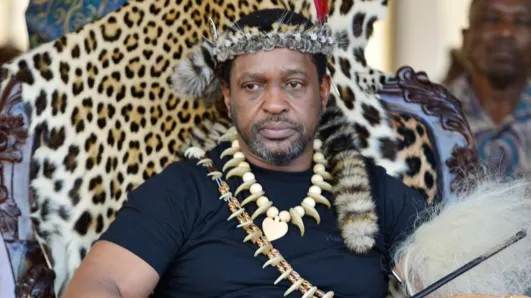
King Misuzulu kaZwelithini call for mining to be banned in KwaZulu-Natal has been met with mixed reactions.
Image: Independent Newspapers Archives
The call by King Misuzulu for the banning of mining activities on land belonging to the Ingonyama Trust Board is facing resistance from labour unions, who argue that the move will deepen the unemployment crisis.
Labour unions said that while mining is a small sector in KwaZulu-Natal, banning it would exacerbate the unemployment crisis in the country.
It was reported recently that the King has stated that he will not allow any more mining in the province due to the behaviour of mining companies and the impact their activities are having on the environment.
Edwin Mkhize, Cosatu leader in KwaZulu-Natal, said in a statement that they noted the King’s concerns, given the historical and ongoing destruction of land caused by some mining operations, non-compliance with environmental laws, and the failure of certain companies to meaningfully comply, advance beneficiation, and promote community development.
“Although KZN’s mining sector is relatively small compared with other industries, it nonetheless plays an important role in sustaining economic activity and supporting jobs. We understand and share the deep concern about the damage mining has caused to land, communities, and local ecosystems in parts of KwaZulu-Natal.
“These are legitimate issues that deserve serious attention. However, we are equally concerned about the possible impact of such a position on jobs and economic stability,” he said. He noted that mining directly employs around 10,888 workers in KZN and contributes about 1.5% to the provincial GDP. Provincial government data also shows that the broader minerals and quarrying sector in KZN contributes under 2% to the provincial Gross Value Added (GVA).
Mining activities in KZN are diverse and significant to the provincial economy. Coal represents the most prominent sector, while other key minerals include titanium, zircon, clay, silica, and sand. Mkhize stated that there are many other beneficiaries through indirect employment and value chains.
“Any sudden policy shift in this sector may deepen unemployment and poverty in a province already battling the economic effects of COVID-19, the July unrest, and floods. At the same time, external shocks such as diminishing trade support from markets like the United States, including challenges related to AGOA, have also adversely affected manufacturing and export-oriented jobs,” he said.
He stated, “As Cosatu, we have a cordial and historical relationship with the Zulu Kingdom. During our 1973 Durban Strike Commemoration, we acknowledged the role played by King Bhekuzulu in representing some of the workers in Durban at a time when workers did not have the right to join trade unions, a recognition that was formalised through a bilateral engagement between Cosatu leadership and His Majesty King Misuzulu. This engagement helped to strengthen the bonds between labour and the Kingdom.
“It is therefore not unreasonable to expect that meaningful engagement with organised labour on matters affecting our members, particularly jobs and economic sustainability, should be possible and welcomed.
“Cosatu therefore urges His Majesty to urgently outline his full plan and proposed alternatives and calls for engagement with labour and all stakeholders to ensure a balanced approach that protects both the land and the livelihoods of workers,” he said.
Sphe Zondi, DA MP and KZN representative on mining, said it is understandable the King would feel that way because of the history of what has happened with mining companies in the province, as well as illegal mining.
“What is important to consider is the amount of direct and indirect employment that mining provides to the province. You look at companies; they employ quite a lot of people directly and indirectly. These are all the things that need to be considered.
“There has to be a balance in looking after the environment, following the laws, and ensuring mining can happen sustainably. So, the King is right to be concerned, but I do think we have to try and balance everything, as well as employment.
“KZN is not at full potential when it comes to mining. I think mining can play a huge role in the economy of KwaZulu-Natal, and we should be looking at making sure we have a sustainable mining industry and that companies are mining sustainably and looking after the environment and following the laws and mining licences required to conduct such operations.”
Mafika Mndebele, the chairperson of the Economic Development Portfolio Committee, said there is a need for engagement. “We believe the department should address the issues raised as a matter of urgency.”
For more stories from The Mercury, click the link THE MERCURY