

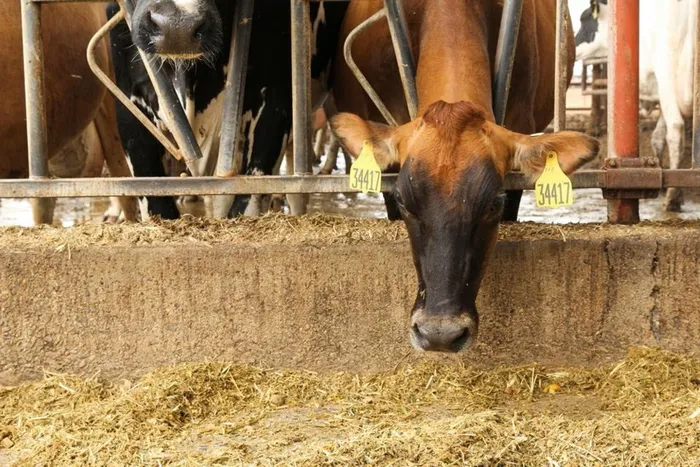
KwaZulu-Natal leaders intensify efforts to combat the foot-and-mouth disease outbreak, as vaccine shipments are awaited.
Image: Supplied
KwaZulu-Natal is awaiting vaccine doses as it grapples with the foot-and-mouth disease (FMD) outbreak which has ravaged the agriculture sector with dairy, commercial, and communal farmers particularly hard hit.
Premier Thami Ntuli, speaking at the Inkosi Msinga Mlaba Sports Complex in KwaXimba on Tuesday, where he met with commercial, communal, and dairy farmers, as well as FMD experts.
Ntuli said KZN is regarded as the epicentre of the outbreak, which is affecting the economy, food security, and livelihoods. The province has nearly 2.4 million cattle, with 207 cases reported. Of these, 187 remain unresolved due to vaccine shortages.
He announced that 1.5 million vaccine doses are expected to arrive in South Africa this week, with the bulk allocated to KwaZulu-Natal. Vaccination will be free, and farmers should not be charged.
At another provincial stakeholder engagement on FMD held at Newcastle Farmers Hall in the Amajuba District on Tuesday, MEC for Public Works and Infrastructure, Martin Meyer, conceded that intervention should have come sooner.
“We should have had these engagements much sooner. We shouldn’t have waited before this became the crisis it is now,” Meyer said, describing the outbreak as one of the most serious challenges the country has faced in a long time.
Meyer stressed that communication is central to controlling the spread of the disease, saying lessons from the Covid-19 pandemic had not been fully implemented.
“Communication is absolutely key to defeating this disease. We’re not getting that right yet, but we’re going to get it right now,” he said.
He urged stakeholders to focus on immediate solutions rather than apportioning blame, noting that cattle hold deep cultural and economic significance in the province.
“For us, cattle is not just an asset. It isn’t just something we own. It’s part of our very fibre, who we are as a people,” Meyer said, adding that the outbreak affects both the economy and the social fabric of KwaZulu-Natal.
Infrastructure challenges featured prominently during the engagement. Meyer confirmed that his department would work with the Department of Agriculture to prioritise upgrades to dip tanks identified as being in urgent need of repair. He also addressed concerns about fencing, which falls under local municipalities, saying his department would engage municipalities to determine how it can assist.
With FMD classified as a national disaster, Meyer said disaster funding would be explored through national government and Treasury, emphasising the need to reprioritise spending during a crisis.
He also highlighted the importance of enforcing livestock movement restrictions, calling for collaboration between road traffic authorities and law enforcement agencies.
Concerns were also raised about buffalo from game reserves, known carriers of the virus, and the condition of perimeter fencing.
Amajuba District Acting Mayor Thembelihle Mthembu said the outbreak has had a profound impact at community level, where livestock represents food security, cultural value, and generational wealth.
“For emerging and communal farmers, livestock often serves as a household’s primary asset,” Mthembu said, adding that prolonged movement restrictions and market uncertainty have placed significant strain on livelihoods.
He described stakeholder engagements as essential for providing clarity, sharing reliable information, and supporting farmers with practical guidance. Mthembu also emphasised that disease control is a shared responsibility, urging compliance with regulations and adherence to biosecurity measures.
Explaining the vaccination process, Ntuli said veterinary teams will administer the vaccines at dip tanks, supported by extension officers across municipalities. Ntuli explained that delays were partly due to global stock shortages and the need to match the vaccine to the specific virus strain.
For more stories from The Mercury, click the link THE MERCURY