

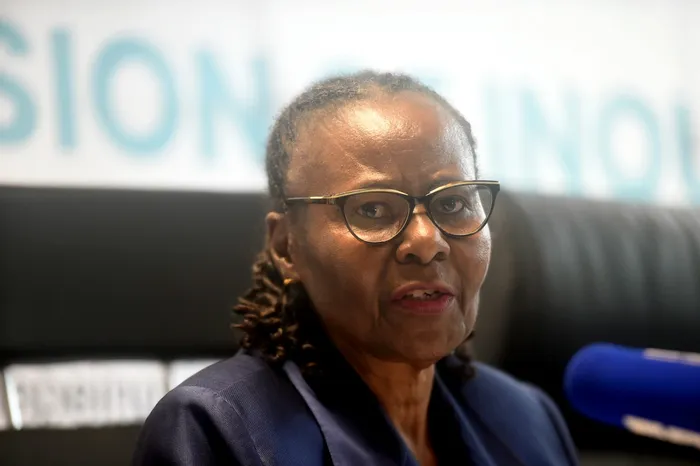
Retired Justice Sisi Khampepe is the chair of the Judicial Commission of Inquiry into the suppression of Truth and Reconciliation Commission (TRC) cases. Former Presidents Jacob Zuma and Thabo Mbeki have sought her recusal.
Image: Itumeleng English / Independent Newspapers
Families of 25 victims of apartheid-era gross human rights violations have warned that the long-awaited Judicial Commission of Inquiry into the suppression of Truth and Reconciliation Commission (TRC) cases is itself being delayed and obstructed, deepening what they describe as decades of denied justice.
In a press statement released this week, survivors and relatives said they approached the High Court in January last year to compel the establishment of a judicial commission of inquiry and to seek constitutional damages against the President and various state entities for failing to investigate and prosecute TRC cases.
“Our court papers illustrate investigations and prosecutions of TRC cases were deliberately suppressed by South Africa’s democratic government, in violation of our rights to equality, dignity, and the right to life and bodily integrity,” the group said. “Such conduct has no place in a constitutional democracy founded on human rights and the rule of law.”
Following a partial settlement, President Cyril Ramaphosa agreed to establish the commission. On 29 May 2025, former Constitutional Court Justice Sisi Khampepe was appointed to chair what is now known as the Khampepe Commission. Its mandate is to investigate allegations that efforts were made to halt investigations or prosecutions arising from TRC matters.
The families described the commission as historic. “The Khampepe Commission represents the first and only time that our long-standing calls for accountability for the failure to investigate and prosecute TRC cases have been formally acknowledged,” they said.
However, the commencement of public hearings—initially scheduled for 10 November 2025—was delayed after separate recusal applications were brought against both the commission’s chairperson and its chief evidence leader. The applications were filed by government departments and former Presidents Jacob Zuma and Thabo Mbeki.
“Both recusal applications were dismissed, and we believe that these actions were aimed at obstructing the work of the Khampepe Commission and, yet again, delaying accountability,” the families said.
They noted that former Presidents Zuma and Mbeki were aware by May 2025 that the commission had been established and that hearings were due to begin in November that year, but only filed their recusal applications in December 2025.
The applications were dismissed on January 30.
At a pre-hearing meeting on February 4 this year, legal representatives for both former presidents indicated their intention to seek a judicial review of the recusal ruling. Former President Zuma has since approached the High Court.
According to the families, the review process could take considerable time, particularly if appeals follow. “We are advised that if the judicial review proceeds while the Khampepe Commission continues with its hearings, there is a risk that the proceedings could be nullified if the review succeeds. Annulment is not automatic, but the risk remains,” they said.
They argue that the irony is significant: “As a result, a judicial commission of inquiry established to investigate decades-long delays and obstruction in achieving justice for apartheid-era crimes is itself being obstructed by actors who want to avoid accountability for actions taken, or condoned, that may have contributed to the suppression of TRC cases.”
The group contrasted the situation with the Madlanga Commission of Inquiry, which they said has “proceeded efficiently and without obstruction”.
While acknowledging that the two commissions have different mandates, they emphasised that both address allegations of obstruction of justice and political interference in constitutionally mandated institutions.
“We expect no less from the Khampepe Commission,” they said.
The families further contended that the failure to hold perpetrators accountable for apartheid-era crimes fostered a broader culture of impunity. “It is our view that the failure to ensure accountability for apartheid-era crimes, and the alleged political interference that followed, created a culture of impunity within state institutions. This accountability vacuum has weakened the criminal justice system and contributed to subsequent systemic failures, precisely the kind now under scrutiny by the Madlanga Commission.”
For many, they said, justice will never be realised in criminal courts. “For many of us, justice has been indefinitely delayed. We will never see those who tortured, maimed, killed, or forcibly disappeared our loved ones held criminally accountable. That right has been unlawfully taken from us.”
They concluded with a call for urgency and cooperation: “Enough is enough. We have waited long enough. The Khampepe Commission must act decisively to ensure that it proceeds without further delay.”
For more stories from The Mercury, click the link THE MERCURY