

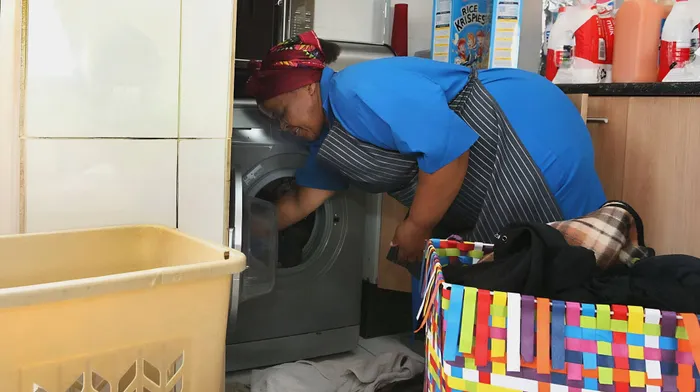
Unions argue that inspections in private households are rare, and workers are often too afraid to report violations for fear of losing their jobs.
Image: Simphiwe Mbokazi / Independent Newspapers Archives
“I still get paid R223 per day,” says domestic worker, *Thandi Yokwe (not her real name). “I have tried to talk to her about giving me an increase, but we fight about it. She fights with me when I bring it up.”
From March 1, South Africa’s national minimum wage increases to R30 per hour, as announced in the latest annual adjustment under the National Minimum Wage Act. The increase applies to all covered workers, including domestic workers, a sector that has been historically undervalued and, for years, excluded from equal wage protections.
On paper, anyone working a full eight-hour day should now earn at least R240 before deductions. But many domestic workers say the new rate will only exist in the Government Gazette, not in the homes where they work.
Pinky Mashiane, founder and president of the United Domestic Workers of South Africa (UDWOSA), says while the union welcomes the increase, it means little without visible enforcement.
"We are unhappy about the compliance and enforcement of the wages for domestic workers. Many employers are not complying with the law," Mashiane says.
She says the union continues to receive complaints from workers who are paid below the legal minimum, work long hours without overtime pay, or are not registered for UIF.
"We want to see the visibility of labour inspectors in private households. We are not seeing this at the rate that we should," she says.
Domestic workers are legally entitled to written contracts, payslips, paid leave, and registration for UIF and compensation under COIDA (Compensation for Occupational Disease Act). Yet, unions argue that inspections in private households are rare, and workers are often too afraid to report violations for fear of losing their jobs.
Mary Nkonyana, a domestic worker for over 25 years and treasurer of the South African Domestic Service and Allied Workers (SADSAWU) based in Cape Town, states that the power imbalance leaves workers vulnerable.
"When they are informed of the increase, they say they can’t afford it. Instead, they cut down the working days, or they tell you that it is better for them to find someone else who they can afford and not keep you. It is a big challenge," she explains.
"Employers confidently choose not to comply with the minimum wage for domestic workers because they know that there is no enforcement from the government. There is also no protection for a domestic worker to keep their job when they report this."
Nkonyana says that even approaching the Commission for Conciliation, Mediation and Arbitration (CCMA) can come at a cost.
"When you speak up and take them to the CCMA, the CCMA will give you a date, and the employer will gather all the documents to show why they can’t afford you, and then the conclusion will be to cut off your days and get even less money, or to let you go. Either way, the domestic worker loses."
As a single parent, she says survival has become an unending cycle of debt.
"I can’t afford anything for myself. I am still underpaid. We live from loan to loan as domestic workers. You may end up having furniture removed from your home because you cannot even repay the loan you took."
In Johannesburg, Yokwe works three days a week, recently reduced to two after she enquired about a salary increase.
After six years with the same employer, her daily rate has not changed.
"By the end of January, I received only R1,700. It is really heartbreaking, and I am praying to get another job elsewhere."
She says she is also expected to cover her own food and transport costs.
In Cape Town’s Claremont area, Veronica Simon has been a domestic worker for 29 years. She says the economic pressure is heavier now than at any other point in her career.
"We are hardly surviving, especially as single parents, given such a high rate of unemployment. Things are still so expensive," she says.
Simon admits she did not know the minimum wage had increased. Even so, she doubts it will change her situation.
"The agreement I made with my employer is that my wages will increase every year, but now it has been inconsistent and has not happened after two years. I’m worried about talking to them because my employer will tell me that there are other people out there who need a job, even though my money is not enough."
Rebecca Kutumela, who has worked in homes across the Western Cape for 22 years, says many domestic workers are still employed without contracts or basic protections.
"We have not signed a work agreement or contract. I work long hours and am not paid enough for it, not registered with UIF, and for COIDA," she says.
Although she feels good about the wage increase, she says it is still not a living wage, and without monitoring, employers may ignore it.
"The employer is aware of the increase in minimum wage, but they will take it lightly because they think that we don’t know anything about it," she adds.
Unions are now calling on the government to strengthen enforcement around the National Minimum Wage, UIF, and COIDA compliance, arguing that gazetted changes are meaningless without inspections and consequences.
"Domestic workers are afraid to speak to their employers, and they are afraid to lose their jobs. Many are not unionised and don’t feel protected," Mashiane says.
They are also appealing to employers who can afford the increase to comply in good faith.
lilita.gcwabe@inl.co.za