

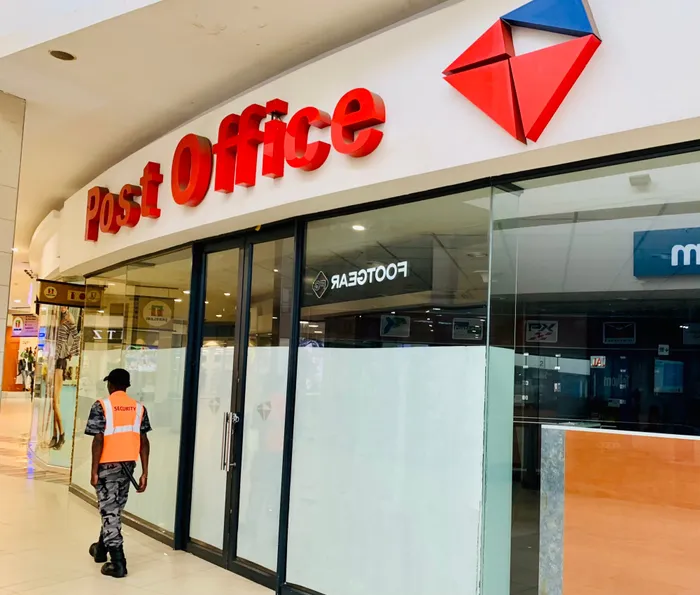
COSATU has demanded urgent government action on what they described as unpaid SA Post Office funding,
Image: Independent Newspapers Archives
A dispute has erupted over the future of the South African Post Office (SAPO) after COSATU raised alarm about what it describes as unpaid government funding, prompting a firm rebuttal from Parliament’s Select Committee on Economic Development and Trade.
The Congress of South African Trade Unions (COSATU) announced that it would be “seeking urgent engagements with the Ministers for Digital Communications and Technology, Treasury, and Employment and Labour to find progressive solutions for the ongoing crises threatening the collapse of the South African Post Office (SAPO) and the jobs of thousands of its employees.”
The federation said it was “extremely worried about reports that the R3.8 billion committed by National Treasury has still not been received by SAPO and that only three out of six agreed to tranches of payments from the Unemployment Insurance Fund’s Temporary Employee Relief Scheme (UIF’s TERS) have been paid.”
“These not only make the long-promised turnaround of the SAPO impossible but also risk its remaining employees’ jobs,” COSATU said.
The trade union federation further warned that SAPO’s Business Rescue Practitioner was reportedly considering liquidation proceedings. “If true, this would be an absolute calamity for SAPO’s workers and their families, the customers and communities who depend upon its services,” COSATU stated.
It argued that allowing SAPO to collapse, particularly if “government funds earmarked to assist its turnaround have not been paid” would undermine years of legislative reforms to reposition SAPO and Postbank.
“The solution to stabilise and set SAPO as well as the Postbank, on the path to sustainability, is not to deny it funds committed to its recovery, nor to apply for its liquidation,” COSATU said. “It is urgent for government to act, including putting in place a far more competent Administrator, actioning a progressive turnaround plan and providing SAPO with the agreed to funding from the Fiscus and the UIF’s TERS.”
In response, the Chairperson of the Select Committee on Economic Development and Trade, Sonja Boshoff, cautioned against what she described as misinformation regarding a R3.8 billion bailout.
“It is incorrect to suggest that the Department of Finance, the National Treasury, is withholding funds that were promised or approved. Repeating such claims risks misleading workers and the public and creates expectations that are not supported by law or fact,” she said.
She stressed that the R3.8 billion figure “originates from assumptions and proposals contained in the SAPO’s Business Rescue Plan”, not from an approved allocation by Treasury.
“The National Treasury has been explicit in its engagements with Parliament, that there exists no legally binding commitment of R3.8 billion that was ever made to SAPO,” Boshoff said.
She further clarified that “in law, public funds can only be released once they have been formally appropriated through the budget process. No such appropriation exists in respect of the R3.8 billion cited.”
While acknowledging interim relief measures including short-term departmental funding and partial UIF-TERS payments, Boshoff said, “These measures do not constitute, and were never intended to constitute, a R3.8 billion commitment.”
Boshoff said, “The absence of a credible, implementable turnaround plan, together with prolonged business rescue processes that have focused on closures and retrenchments rather than operational recovery, has materially weakened the SAPO’s financial and operational position.”