

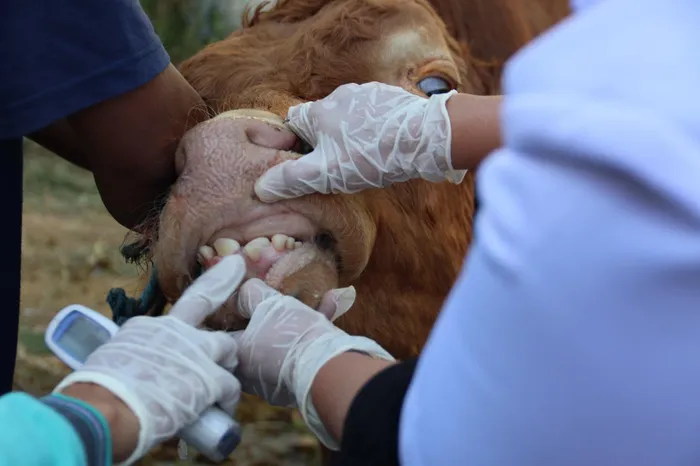
Farmers in South Africa voice urgent concerns over the government's delayed response to the Foot-and-Mouth Disease crisis, calling for immediate vaccine rollout to protect their livelihoods and the nation's food security.
Image: Supplied: University of Pretoria
President Cyril Ramaphosa’s declaration of Foot-and-Mouth Disease (FMD) as a national disaster in his recent State of the Nation Address (SONA) has been met with a mixture of desperate relief and bitter scepticism from the farming community, who have been battling the devastating outbreak for months.
While the commitment to centrally acquire 28 million vaccines for the national cattle herd is seen as a crucial step, many farmers argue the intervention is “long overdue” and question the government's capacity and urgency to execute the plan.
For dairy farmer Amy Gace from KwaZulu-Natal (KZN), the financial and emotional toll is immense. “Financially, we have lost about R10 million, and emotionally, I am broken,” Gace stated bluntly.
Gace believes that without immediate access to vaccines, the situation is spiralling out of control. “They are just messing around. Time is of the essence, it's crucial, it's a runaway fire, and we need vaccines yesterday.”
Gace has lost trust in the government’s handling of the crisis, calling them “a bunch of liars”.
She lamented the lack of decisive action following the outbreak about 18 months ago, arguing that national vaccination then “could have preempted everything that we are going through now… how the disease has spread, and the disaster that it has caused should never have happened.”
The danger, she warns, extends far beyond the cattle farmers themselves. “Everyone who relies on the dairy farmer for their own income, the domino effect will be significant,” Gace stated, adding that “it’s all just a little too late” and calling for “the private sector needs to take control of the vaccines”.
Pig farmers feel completely overlooked in the government's response, which currently focuses only on beef and dairy herds.
KZN pig farmer Michelle Moscou questioned the inequity, stating: “I am a small-scale farmer with pigs and this is my only source of income, but I am getting no information or assistance with regard to the vaccine being available for pigs, only the dairy and beef herds.”
According to Moscou, the local state vet office has advised that no vaccine will be allocated for pigs, despite the fact that pigs contract the virus. She noted that her queries to the government have gone unanswered.
Ariena Shepherd, KZN chairperson of the National Wool Growers Association, echoed the sentiment of delay and mismanagement, stating that the country should never have reached this point.
“We’ve known about this since April last year; if decisive action had been taken and things followed the way they should have happened, we should never have gotten to a state of disaster,” Shepherd said.
She believes the problem could have been solved quickly if the government had acted decisively on the vaccine acquisition.
Shepherd emphasised the devastation and vulnerability of communal farmers. “People have no idea the impact this has had on cattle and dairy farmers in the country. I’m in Natal, and there are these old ladies who have got five or six cows, and they're desperate. They can't sell an animal to pay their kids' school fees.”
For Shepherd, the disaster is entirely “government-made”.
She recalled opposition from the government when farmers, following international protocol, sent samples for testing in March, stating: “We faced strong opposition from the government. You can't do this. This shouldn't be happening.”
Shepherd also shared the emotional trauma in the dairy sector: “I've seen big men cry because they are losing 20% of their animals; they've lost so much. And the emotional impact when you see the animal suffering. It's not right. It shouldn't be happening.”
The response from organised agriculture, while welcoming the national disaster declaration, highlights the urgency and the need for clarity.
Angus Williamson, Kwanalu vice president and Red Meat Producers Organisation (RPO) KZN chairperson, confirmed the widespread nature of the outbreak: “It is a runaway fire that could have been prevented… FMD is in every district across KZN.”
He described the national disaster declaration as “long overdue intervention”, noting that Kwanalu had requested the declaration from a provincial perspective back in May.
While cautiously optimistic, Williamson said: “We do welcome the national disaster, and we hope for more clarity regarding exactly how the rollout is going to take place. We do believe that early in the coming week, we will have clarity.”
The key, he stressed, is speed: “We hope to get the vaccine into the cattle as soon as humanly possible. That is the only thing that is going to stop the scourge of Foot-and-Mouth going right across the country and creating more of an economic disaster than it currently has.”
Bennie van Zyl, TLU SA general manager, expressed deep concern over the lack of urgency and the threat to food security. “A lot of farmers are negatively affected by this and have already started losing their farms, and food security at this stage is already at stake,” he warned.
Van Zyl questioned the capability of state institutions, even with the disaster declaration.
“The question that we should answer is, do they have the capacity to bring something on board so that we can address this much quicker and better?”
He also questioned the timeline for vaccine acquisition, stating that it was announced last year that SA’s 14 million national herd would need to be vaccinated.
“Since last November until now, why don't we have the vaccines already?” Van Zyl asked, given that the government knew the country lacked the capacity to produce the needed quantity for 14 million cattle.
For TLU SA, the critical missing elements are a “sense of urgency and acceptance of responsibility. That’s what we need now”.
Meanwhile, Minister of Agriculture John Steenhuisen has taken steps to integrate the wildlife sector into the response, appointing Dr Gary Bauer to the Ministerial Task Team.
Steenhuisen stated: “The wildlife sector must be fully integrated into our FMD Recovery Plan. Buffaloes are central to the epidemiology of this disease in southern Africa. Any serious strategy to restore our status must account for that reality.”
karen.singh@inl.co.za