

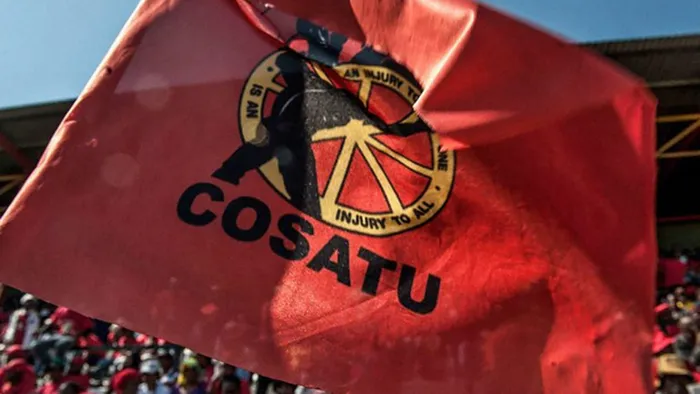
Cosatu said it is concerned about the notion that public resources should be used to save embattled private companies. It was commenting after news that the embattled Tongaat Hulett is facing possible provisional liquidation.
Image: File.
Trade union federation Cosatu is warning against any “irresponsible” use of public resources to save the embattled Tongaat Hulett which is facing possible provisional liquidation, a move that will have a profound impact on KwaZulu-Natal's agricultural economy and the sugar sector as a whole.
In a statement, Cosatu in KwaZulu-Natal expressed deep concern over the collapse of the business rescue process at Tongaat Hulett, adding the development poses a serious threat to jobs, the provincial economy, local supply chains, and the livelihoods of workers and communities who depend on the sugar industry.
However Cosatu KZN provincial leader Edwin Mkhize warned against the state rushing in to save the company.
“Cosatu KZN rejects the dangerous narrative that the state must rescue private capital without accountability. It would be criminal and morally indefensible for public funds, generated through the taxes of workers and the poor, to be used to save private companies that have historically enriched shareholders, executives, and monopoly capital, while suppressing wages and deepening poverty. We must save jobs, but with conditions and accountability.
“We are clear: South Africa cannot afford to lose a single job. KwaZulu-Natal, in particular, is already suffering from deep unemployment, poverty, and inequality. The collapse of Tongaat Hulett will worsen this crisis and undermine efforts to rebuild the provincial economy. For this reason, Cosatu KZN supports urgent government intervention to protect jobs, stabilise the sugar sector, and the economy. However, we state unequivocally that any state intervention must come with strict and non-negotiable conditions," said Mkhize.
He stated that if the government is expected to inject resources into Tongaat Hulett, then the government must not act as a charity for private capital. The state must intervene in a manner that advances public ownership, worker control, and long-term industrial sustainability.
“Cosatu therefore demands that any financial support or intervention from the Department of Trade, Industry and Competition (DTIC) or any state institution must include amongst others that equity ownership by the state and workers in exchange for any public funding.
“We will not allow state resources, money belonging to the people, to be abused to protect the profits of private capital. The time has come for a new economic path where workers and communities are placed at the centre of industrial development, ownership, and decision-making,” he said.
Meanwhile Agriculture Minister John Steenhuisen said the department has been engaging with industry stakeholders and has been informed that, unless the current funding impasse is urgently resolved, growers will be unable to deliver cane and processing will come to a halt.
The department said the consequences of such an outcome would be severe, affecting approximately 15 500 delivering growers and between 35 000and 40 000 people whose livelihoods depend directly on the supply chain linked to the mills.
“This is not a theoretical risk, it is an immediate economic threat to rural communities,” Steenhuisen said.
“If the mills do not open, farmers cannot harvest, workers cannot earn an income, and entire local economies will stall. The longer uncertainty persists, the greater the damage becomes.”
The department said it is engaging with the relevant departments and financing stakeholders to support a practical solution that preserves production capacity and avoids irreversible losses in the sector.
For more stories from The Mercury, click the link THE MERCURY