

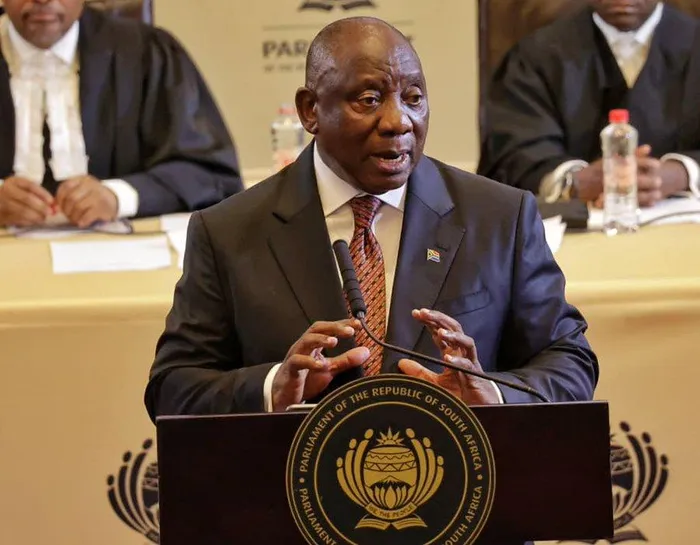
President Cyril Ramaphosa announced during his State of the Nation Address that he intends to establish a court that will address commercial and business disputes to ensure that such disputes do not halt investments.
Image: GCIS
The proposal to establish a specialised court to urgently resolve business disputes has been hailed as a key step that will give certainty and confidence to investors whilst ensuring the speedy implementation of infrastructure projects.
That is the view of the business community, which described the move announced by President Cyril Ramaphosa recently as the first step in addressing bottlenecks that delay investments. However, while the legal fraternity welcomed the announcement as a good idea, they said it fell short of what the country needs to maximise the delivery of justice.
Ramaphosa announced during his State of the Nation Address that he intends to establish a court that will address commercial and business disputes to ensure that such disputes do not halt investments.
“Disputes arising from the implementation of tenders often delay the implementation of necessary infrastructure.
“To prevent undue delays in critical projects, we will establish specialised courts for commercial matters with dedicated judges and dedicated court rolls to ensure faster outcomes in matters that have a bearing on the economy and development,” he said.
Andrzej Kiepiela of the KZN Growth Coalition said the business community welcomes anything to do with the reduction of red tape, corruption, and unfair practices.
“Unfortunately, throughout the province and the country, there are many problems related to procurement and obstacles to having competitive processes that are short, on point, and legal, which will lead to increased investments. Therefore, we welcome the President’s announcement to create more courts aimed at minimising the dispute resolution process.”
Brian Mpono, the CEO of the Oceans Umhlanga Development, said this was an important step, adding that difficulty arises when disputes take too long to resolve, causing projects — even lawful ones — to become financially or socially unviable before a judgment is reached.
“The success of such courts will depend on balance; they must accelerate decisions without lowering scrutiny. If achieved, this reform would not favour developers — it would favour implementation. Ultimately, economic growth depends on implementation,” said Mpono.
From a development and investment perspective, he added, the impact could be significant in that it could lead to predictability for investments.
“Capital avoids uncertainty, and defined timelines and commercially literate adjudication allow investors to price risk properly and proceed with confidence.
“Continuity of catalytic projects is essential, as large developments operate within funding, planning, and infrastructure sequencing windows. When disputes remain unresolved for extended periods, the broader public benefit — jobs, housing, transport, tourism, and urban activation — is delayed. Speedy resolution protects both legality and delivery.”
Mbekezeli Benjamin, a research and advocacy officer at Judges Matter, said: “This is not a bad idea. It just misses the point. South Africa does need more courts and more judges, but not in the way the President intends. In fact, implemented unchanged, Ramaphosa’s plan would be a waste of resources.”
He said Ramaphosa’s proposal is likely informed by a genuine concern about the infrastructure implementation delays caused by a slow adjudication system in a complex and highly litigious area of the law. “While creating a dedicated court to deal with similar cases seems like an attractive proposition, it is still not an effective solution.
“Firstly, where would this court be located? Secondly, these sorts of cases usually take a long time from the initial filing to when the case is ripe for hearing. What would the dedicated judges do in the meantime — twiddle their thumbs? A better solution would be to first increase the number of judges across various High Court divisions. This immediately increases the judicial capacity to carry out this specialised work, but also assists in other areas.”
Mafika Mndebele, chairperson of the Economic Development Portfolio Committee in KwaZulu-Natal, said this intervention is long overdue, as prolonged litigation has become a major constraint to economic development, infrastructure delivery, and investor confidence.
“Delayed resolution of procurement disputes has had the unintended consequence of stalling catalytic projects, escalating costs, and undermining the state's capacity to stimulate inclusive economic growth.
“In this regard, specialised courts with the requisite technical expertise would significantly reduce turnaround times, provide certainty to investors, and ensure that legitimate disputes are resolved swiftly without paralysing development initiatives,” he said.
There have been several infrastructure projects that have been stalled by legal challenges, leading to them being delayed for years. At least four projects in recent years were hamstrung by lawsuits in Durban, putting the projects in jeopardy.
For more stories from The Mercury, click the link THE MERCURY