
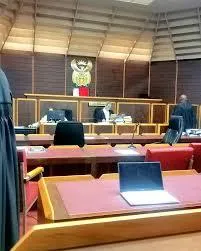
The Pietermaritzburg High Court has been temporarily closed due to a water outage.
Image: Instagram
The Msunduzi Municipality is investigating possibilities of sabotage in its water supply infrastructure following an outage that has seemingly only targeted the Pietermaritzburg High Court and the Department of Rural Development and Land Reform (DLRRD) buildings.
EFF councillor in the municipality, Chuma Wakeni, revealed the possibilities of sabotage on Thursday, a day after the Office of Chief Justice Mandisa Maya had announced the temporary closure of the High Court.
The water supply interruption in a small part of the city, which started on February 10, has entered its second week, with no success in restoring it.
This had also affected the daily operations of the only Deeds Registry office in KwaZulu-Natal.
The Deeds Registry is housed inside the DLRRD building in Pietermaritz Street, which is adjacent to the High Court.
Wakeni said the suspicion of sabotage was based on the fact that most parts of the city have a normal water supply, but only these two essential public institutions have dry pipes.
“There is nothing of a burst pipe, leaks, or loss of water from our water infrastructure, and everything is on board.
“The municipality is looking into it to check if there is any sabotage because out of our 41 wards, it is only these two institutions that have been affected.
“They (municipality) will investigate and come back to us because the infrastructure is functional,” said Wakeni.
Maya’s office said on Wednesday that attempts to get the water supply restored at the High Court building have been exhausted.
Her office has since advised all users of the court, including members of the public, legal practitioners, and staff members, that the court was temporarily closed on Wednesday.
“The area has been experiencing an ongoing water shortage since 10 February 2026, which has impacted court operations.
“Internal contingency measures have since been exhausted, leading to the temporary closure of the building,” read the statement.
It said affected parties will be contacted regarding alternative arrangements for all matters scheduled on the court roll.
Provincial National Prosecuting Authority spokesperson Natasha Ramkisson-Kara referred all questions about how much this situation has affected criminal cases to the Department of Justice.
The Msunduzi Municipality, which is the supplier of water in Pietermaritzburg, also stated on Wednesday that technicians were investigating the cause of the water disruption and implementing the necessary corrective measures to ensure a sustainable resolution.
“The municipality is aware of the prolonged water outage currently affecting the High Court and the Deeds Office precincts, and acknowledges the inconvenience this has caused to operations, staff, and members of the public who rely on these facilities,” the statement read.
The municipality said restoring the water supply was its priority as it has dedicated resources and technical expertise to ensure that normal services are reinstated at the earliest possible time.
“We appreciate the patience and understanding shown by the affected institutions and the public while our teams work diligently to address the situation.
“Updates will be provided as soon as there is significant progress or once the matter has been resolved.
“The municipality remains committed to maintaining reliable water services and will continue to take all necessary steps to prevent prolonged disruptions wherever possible,” the statement read.
DA councillor Ross Strachan linked the outage to ageing, poorly maintained infrastructure, and inadequate operational management.
“From information received, this outage forms part of a wider disruption to water supply in and around the Pietermaritzburg CBD, with several buildings and businesses experiencing intermittent or no supply over the past few days,” said Strachan.
He accused the municipality of failing to provide information on the cause of the situation.
“The municipality has yet to provide a clear, detailed explanation of what caused this specific outage or a firm timeline for restoration.
“The DA is calling for an urgent technical report on the cause of the outage, immediate remedial work to restore supply, and a credible plan to prevent repeat failures. That lack of transparency is unacceptable.”
He called on the provincial government to conduct an oversight.
“The collapse of basic services in Msunduzi is now directly undermining access to justice, economic activity, and essential government functions,” said Strachan.
The historical water outage have frustrated many residents in the city, as schools were among the public institutions that had been suffering the consequences for years.
Amakholwa High School, Snathing Junior Primary School, and KwaMpungose Senior Primary School in Edendale have been operating on a half-day schedule for several months, since last year and for many weeks this year, because teachers and learners have been unable to use the toilets due to the absence of water, which was also required to cook the school nutrition meal for learners.
Teaching and learning would start at 7.30am and end before 12 midday so that teachers and learners could go home earlier.
Parents attributed the drop in the matric pass rate at Amakholwa school, from 2024’s 98% to 66% last year, to the prolonged and unattended water outages.
The local Ward 11 Councillor Sanele Zuma also attributed the water crisis in the ward to a deliberate sabotage of water infrastructure.
Two days after the water outage hit the High Court and DLRRD buildings, the South African Communist Party (SACP) issued a statement on February 12, expressing its concern about the crisis that is affecting the country.
“The water crisis is not a mere momentary interruption but has now become a standing crisis, not affecting isolated communities but affecting all across the country, with the working class and poor being the most impacted.
“The lack of water in our communities is a result of both the objective collapse of infrastructure because of its gross mismanagement, but also a result of deliberate neglect and manipulation connected to tenderpreneurs and corrupt municipal officials who loot state resources through emergency water provision.
“The water mafia with water tankers continues to operate and indeed thrive,” read the SACP statement.
The party called on President Cyril Ramaphosa to institute immediate measures to alleviate this crisis by empowering municipalities not to rely on tenderpreneurs to deliver water.
“The use of the private sector in the provision of services has proven detrimental to the welfare of the people and can no longer be justified going forward,” the party said.
bongani hans@inl.co.za