

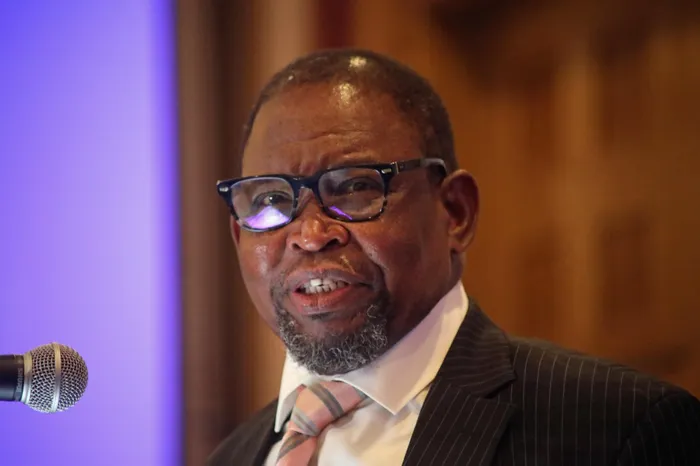
Finance Minister Enoch Godongwana must navigate a storm of demands for tax relief and urgent reforms in his upcoming 2026 Budget Speech.
Image: Timothy Bernard / Independent Newspapers
Finance Minister Enoch Godongwana is facing an unprecedented “pincer movement” of demands from across the political and social spectrum as he prepares to deliver the 2026 National Budget Speech this Wednesday.
From political parties to powerful trade unions and industry bodies, the message to the National Treasury is blunt: South Africans are "deeply overtaxed," the energy grid is at a breaking point, and small businesses are suffocating under a mountain of red tape and late payments.
Dr Mark Burke MP, the DA’s spokesperson on Finance, called for an immediate end to "bracket creep", a phenomenon where inflation pushes taxpayers into higher tax brackets without an increase in actual purchasing power.
"South Africans are deeply overtaxed. Budget 2026 must see adjustments in tax brackets and rebates in line with inflation," Burke said in a statement released Monday. "We can’t afford another year of stealth taxes, and we definitely can’t afford explicit increases."
The DA said it is expecting no hikes in personal income tax, corporate tax, or VAT. Burke also highlighted a ticking time bomb in the national accounts: debt service costs.
"Our country spends 22 cents of every rand on debt service costs that are now crowding out health, education, and police spending," he warned.
The IFP said that regressive measures must be revisited in this year's Budget.
"South Africans cannot withstand policy decisions that increase transport costs, raise food prices, or worsen inequality. The 2026 Budget must demonstrate a truly pro-poor orientation, with targeted relief for low-income and working-class households."
While the lights may be on for now, the Energy Council of South Africa (ECSA) warns that the stability of the grid remains the nation’s Achilles' heel. CEO James Mackay urged Godongwana to announce measures to accelerate electricity infrastructure delivery.
"Energy security remains the single most important constraint to the Government of Unity’s priorities," Mackay said. He noted that while the newly formed Department of Energy and Electricity (DEE) has "positive momentum," the task ahead is "monumental."
"Private sector investment is well-positioned to respond to clear and competitive price signals... This will, however, only be realised if supported by a clear and phased transition plan to 2030," Mackay added.
On the labour front, the trade union UASA painted a "gloomy" picture of the daily struggle for South African workers.
UASA spokesperson Abigail Moyo said the budget must move beyond rhetoric and address the "real challenges" of high inflation and unemployment.
"Consumers are tightening their budgets to cover basic household needs, while businesses face low growth, retrenchments, and liquidations," Moyo said. "Workers cannot be expected to shoulder the cost of fiscal consolidation alone."
UASA is calling for a "strategic" speech that stabilises food and fuel costs while pumping money into the revitalisation of passenger rail to improve worker mobility.
For more stories from The Mercury, click the link THE MERCURY