

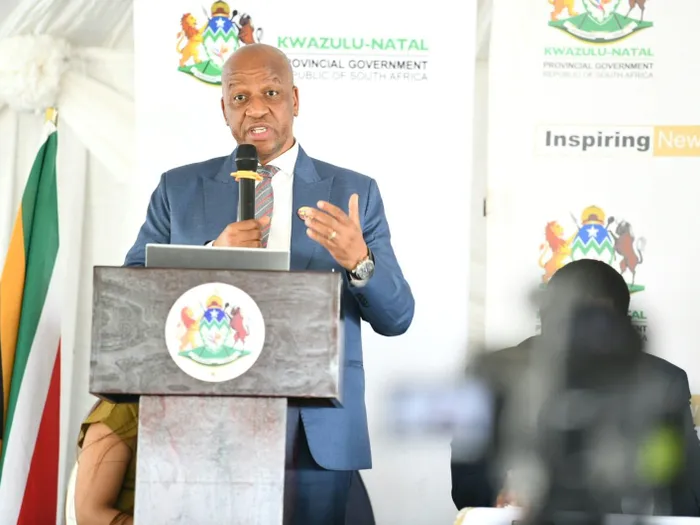
KZN Premier Thami Ntuli warns business owners of immediate arrests for hiring undocumented foreigners, as the province escalates its crackdown on illegal immigration.
Image: Supplied
KwaZulu-Natal Premier Thami Ntuli has issued a stern warning to business owners across the province, declaring that those employing undocumented foreign nationals will face immediate arrest as the provincial government intensifies its crackdown on illegal immigration.
Speaking at a high-level multi-sectoral roundtable at the Archie Gumede Conference Centre on Tuesday, Ntuli made it clear that the provincial government is moving beyond "symbolic" gestures to more aggressive enforcement.
“All employers who are employing undocumented foreign nationals must be arrested,” Ntuli said. “There is no discussion around that. They are breaking the law.”
The Premier’s remarks come as the province ramps up its campaign, Ongangeni Ngesango, Uyafohla, a community-centred intervention aimed at restoring the rule of law.
Ntuli argued that the "normalisation" of illegal immigration undermines the integrity of the state and facilitates criminal syndicates involved in human trafficking, drug smuggling, and unlicensed firearms.
"When borders are disregarded, it is not compassion that prevails, but criminal syndicates that exploit desperation," Ntuli said. He noted that the issue has permeated even "far remote rural areas," where undocumented nationals are reportedly operating spaza shops and being allocated land by local authorities.
The roundtable laid bare the immense strain placed on provincial resources. According to the Department of Education (DOE), KZN is currently home to 149,619 undocumented learners.
While the majority of these—over 130,000—are South African citizens lacking paperwork, the province has 18,793 undocumented foreign learners.
Despite the administrative burden, Education HOD Nkosinathi Ngcobo, explained that schools are constitutionally "bending over backwards" due to the 1996 Constitution and the landmark Phakamani judgment, which prevents schools from turning children away based on their documentation status.
Similarly, the Department of Health revealed a significant data gap. Health HOD Penny Msimango admitted that the department currently does not separate data based on nationality. This "blind spot" has led to poor disease surveillance and a high "loss to follow-up" rate, as undocumented patients often provide incorrect contact details, making it impossible to manage outbreaks or ensure treatment adherence.
The government’s position was met with sharp criticism from civil society. Jacinta Ngobese-Zuma, representing the March and March organisation, challenged the state’s reliance on court judgments to justify the strain on public services.
“Why is our government bending over backwards to stretch our public resources to give to people who have a government that is supposed to be provided for them?” Ngobese-Zuma asked. She urged the provincial leadership to challenge the "Phakamani" judgment in court, citing that the Constitution only requires the state to provide services within its "available resources."
Premier Ntuli revealed that he has taken the fight beyond provincial borders, personally visiting the Mozambique and Eswatini and engaging directly with foreign diplomats.
“Illegal immigration is not merely a domestic enforcement issue. It is a transnational challenge that requires shared responsibility,” Ntuli said. He called on embassies and high commissions to become "active partners" in the repatriation and documentation process, asserting that "cooperation without enforcement will not end" the crisis.
The Premier concluded by stating that the province is turning a corner, with plans to increase the number of border patrollers and enhance surveillance technology to safeguard the province’s economy and security.
For more stories from The Mercury, click the link THE MERCURY