

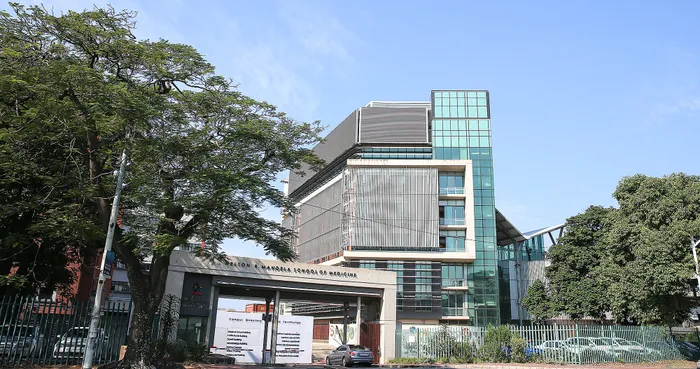
The corruption case involving admissions to the Bachelor of Pharmacy programme has been postponed to May.
Image: Leon Lestrade / Independent Newspapers
Financial woes and documentation problems overshadowed Durban Regional Court proceedings in the corruption case of the University of KwaZulu-Natal (UKZN) Bachelor of Pharmacy programme admissions on Tuesday morning.
Seven people are charged: Salman Noor Mohamed, his mother Mirriam Mohamed, Muhammad Altamish Haniff, Preshni Hiramun, the married couple Varsha and Hiteshkumar Bhatt, and their son Bhavik Bhatt.
They are accused of offering payments to Ruth Sekati, a senior education IT specialist at UKZN, to manipulate the university's admission systems.
The goal was to secure placements in the Bachelor of Pharmacy programme at the Westville Campus for three students — Salman Noor Mohamed, Muhammad Altamish Haniff, and Bhavik Bhatt — in February and March 2017, despite them having inadequate matric results for the highly competitive programme.
The charge sheet alleged proposed payments of up to R50,000 per student. Actual payments reportedly involved R50,000 for Mohamed's admission (split into R47,000 and R3,000), R20,000 for Haniff, and R10,000 for Bhavik Bhatt.
Charges further claim that no placements for Indian students were available during Bhavik Bhatt's admission period.
Defence attorneys highlighted significant issues with the completeness of the case bundle, which prevented the pre-trial conference from moving forward.
Wesley Rogers, representing the Bhatt family, pointed out significant deficiencies in the documentation. He stated his intention to meet informally with the State to compare documents and identify further missing materials.
Rogers also challenged the investigation’s methodology by requesting access to documents discovered during related High Court civil proceedings involving KPMG consultants commissioned by the university.
He explained: “In the High Court, there was a civil matter in terms of PIIA (Personal Information Impact Assessment) in relation to an operation that culminated in this prosecution. I have requested the information that was discovered in those proceedings, and the prosecutions have said that they have not been able to lift the same.”
Rogers claimed that police had minimal involvement, questioning the fairness of the pre-trial process and underscoring the importance of this information. Rogers also indicated plans to apply to compel the disclosure of the investigating diary, contained in the docket's C clip, following the State’s refusal.
Jacques Botha, counsel for Preshni Hiramun, also cited documentation problems and revealed he had not been paid.
“Already from what I have been through, I have found missing logs and missing annexures, and these are from substantial witnesses; there seems to be quite a lot of things missing,” Botha told the court.
Amid these concerns, attorney Sandeep Singh, representing Muhammad Altamish Haniff, confirmed he had submitted representations seeking the complete withdrawal of charges against his client.
State Advocate Siyabonga Majola defended the investigation’s credibility, noting that three separate dockets were involved and emphasising that procedural safeguards surrounded specific evidence.
Magistrate Dawn Soomaroo acknowledged the numerous outstanding documentation issues, concluding that they prevented the progression of the pre-trial conference.
She ordered the prosecution and defence teams to meet and resolve the documentation disputes by March 25. The proceedings were then adjourned on May 4 for a pre-trial readiness assessment.
The magistrate also instructed Botha to clarify his funding status with his clients by March 25, and specified that the State must respond to Singh’s representations by May.
nomonde.zondi@inl.co.za