

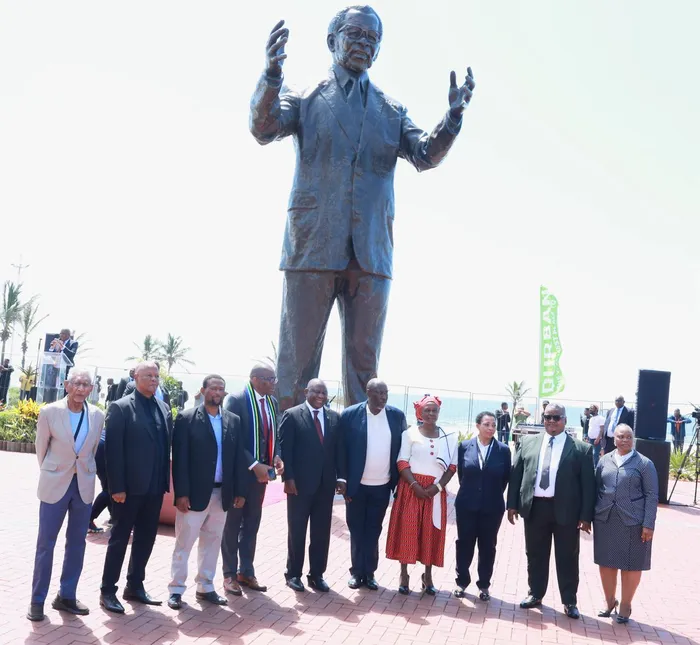
President Cyril Ramaphosa, accompanied by city and national government officials, at the unveiling of the Oliver Tambo statue in Durban yesterday.
Image: GCIS
President Cyril Ramaphosa has dismissed the outcry over the money spent to erect statues of two struggle icons in Durban, pointing out that the historic symbols’ value far exceeds the economic cost.
The president on Tuesday unveiled two statues, one of Oliver Tambo and the other of Nelson Mandela, which were erected in Durban.
The statues have been a subject of controversy after it emerged that R22 million had been spent on them. The statue of Tambo is located close to North Beach, while that of Mandela is erected near the Moses Mabhida Stadium.
The unveiling of the statues was attended by several dignitaries, including a representative from the Tambo family and ANC stalwarts such as Jeff Radebe and Mac Maharaj. The president said,
“We know that the issue of statues attracts controversy like everything in our country, but those complaining should stop, and we should think about this,” adding that these statues represent an iconic part of the country’s struggle for liberation.
“We’re proud that the eThekwini Municipality has bestowed this honour on the struggle icons. Monuments of this nature are important for representing the country’s rich history and heritage as a people; they anchor the collective memory of a nation.”
He added that the statues would be a major tourist drawcard and that he would kick off the tourism boom by inviting SADC heads of state to lay wreaths at the statues when they attend a SADC meeting in Durban this year.
Mayor Cyril Xaba spoke on the importance of the statue of Tambo and what it represents.
“The towering statue of Oliver Tambo on the beachfront reminds us of his journey across oceans, convincing the world about the importance of breaking down the walls of apartheid. This statue is not just a symbol of his heroic role and exemplary leadership; it immortalises the life of a man who laid the foundation for a new nation.”
Xaba added, “Steeped in diplomacy, he produced a document that came to be known as the Harare Declaration, which set out the conditions under which negotiations for a democratic South Africa may take place. This is a leader who consistently reminded us that unity and discipline were essential for victory against apartheid. Indeed, both these leaders were architects of our democracy, peace, and reconciliation.”
Regarding the statue of Mandela, he remarked that it is a reminder of his landmark address that came to define his philosophy behind his project of nation-building.
“You will recall that two weeks after his release from prison in 1990, former President Nelson Mandela addressed his first major mass rally in Durban at Kings Park Stadium. The rally drew more than 200,000 people from across the length and breadth of our province, eager to see him for the first time after 27 years of incarceration on Robben Island.
“We trust that these statues will inspire present and future generations to learn more about the immense contributions these struggle icons made in building the democratic South Africa we enjoy today,” the mayor said.
The DA in KwaZulu-Natal staged a protest against the unveiling of the statues, expressing concerns about the cost.
A small group of DA members demonstrated outside the venue, arguing that the statues should not have been a priority in light of the myriad challenges faced by the municipality.
“We are here to raise our voice in hope that our president will listen to us. We have written a letter; he has not responded. In the state of the nation address, Ramaphosa said he is going to hold responsible municipalities that are not providing water, but two weeks later, he is here in Durban to unveil a statue of shame, because this is what this is to us. R22 million has been spent on statues in a city where people do not have water,” said Haniff Hoosen, DA mayoral candidate for eThekwini.
He added that this was a serious failure on behalf of the government and pointed out that there are people who have been waiting for services for the last 30 years.
For more stories from The Mercury, click the link THE MERCURY