

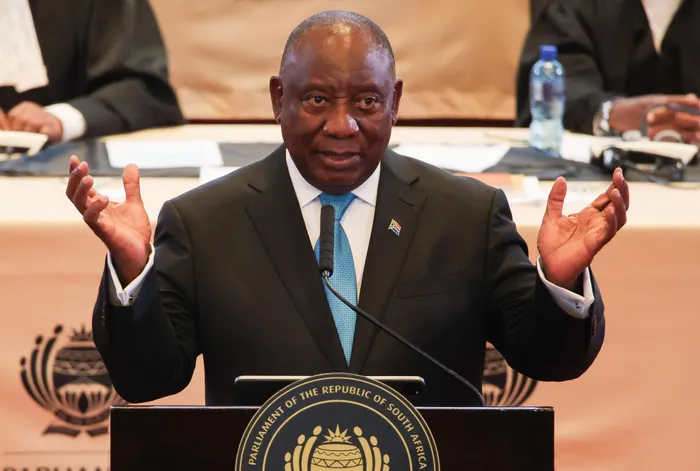
President Cyril Ramaphosa
Image: IOL
The Presidential eThekwini Working Group is beginning the next phase of its work to ensure that Durban grows to be one of the most competitive business and tourism destinations in the world.
President Cyril Ramaphosa stated yesterday that the next phase of the working group will be focused on economic growth. This comes as the group is being lauded for the work it has already done to stabilise service delivery.
The president was speaking in light of the growing business confidence in the city. A recent study looking at business confidence in Durban has found that the business community’s confidence in the city is as high as it has ever been.
This is a far cry from two years ago when the same business community complained about the near collapse of service delivery, which prompted the immediate setup of the Presidential eThekwini Working Group to help the municipality navigate the service delivery challenges.
Addressing the meeting on the second phase of the intervention, Ramaphosa said it should focus on economic growth and ensure that the gains made so far are not eroded, leading to the city being able to operate without oversight from the Union Buildings.
“Today, to launch the second phase of our partnership, this has, in my view, been the most meaningful partnership. When I was here two years ago, I met with many of you who are in business, and you gave me a rundown of the challenges.
“Let me say this without heaping praise on you here in eThekwini, the model (presidential working group) that you have enabled us to build has been the most effective, and we have found you (city officials and business) to be the most cooperative bunch of people to work with. But in the end, the real witnesses are the people in our country who see Durban as the mecca of our tourism desires.
“After two years of the Presidential eThekwini Working Group, there are tangible signs that the decline has been treated, stability has taken root, and that recovery is definitely underway. The next area of focus for the Presidential eThekwini Working Group will be on economic development,” he said.
He said while the government applauds this progress, stabilisation is not the same as transformation. He said there are still serious problems that need to be addressed.
“Two-thirds of businesses still believe that service delivery complaints may not be attended to in reasonable time frames. Environmental issues and roads remain areas of concern. Another area of concern is non-revenue water, which stands at 55%, far above acceptable benchmarks. This represents lost revenue and lost opportunity.
“The second phase of the working group will therefore focus on issues of economic development,” Ramaphosa said, adding that part of this will look to unlock infrastructure investment at scale.
“The Department of Trade, Industry and Competition will need to play a greater role in the working group as we face challenges such as illicit trade. If eThekwini is to compete with other metros, we must reduce friction in development planning, accelerate approval, and reform cost structures that deter investment.
“This falls in the realm of ensuring red tape is minimised so that your business functions as effectively as possible. You need to tell us where there are ‘silly’ rules that impede your business; we need to ensure we lay out the red carpet and take out the barriers that impede your business,” the president told the business people.
Overall, Ramaphosa said he was so pleased with the state of improvement in eThekwini that he will be rewarding the city with the hosting of the SADC Heads of State meeting in August, where Durban will host close to 14 heads of state.
“They will not be coming alone; they will be bringing money,” he said.
Minister of Cooperative Governance and Traditional Affairs Velenkosini Hlabisa said eThekwini has the ability to become one of the best cities in the world for business and leisure.
“To the business community, thank you for staying at the table and participating and not just being critical. The people of eThekwini should experience the benefits not just in our speeches but in reliable services.”
Premier Thami Ntuli acknowledged the work done by the business sector and partnership in the intervention.
“The government creates an environment where business drives investment,” said Ntuli.
“If the local government fails, our people feel it first and harder. The intervention by the president has boosted investment, as seen with the R100 billion pledged.”
Moses Tembe of the KZN Growth Coalition said the government should be acknowledged for the state of eThekwini. “We must appreciate the good work that the government has done.”
For more stories from The Mercury, click the link THE MERCURY