

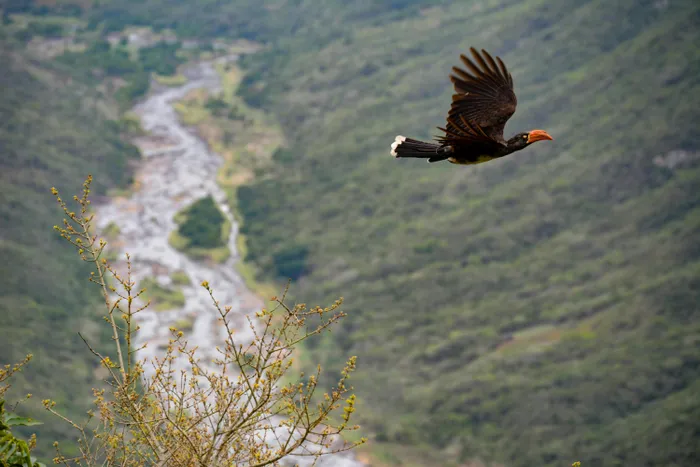
A hornbill flying over the Oribi River in between the Oribi Gorge on the KZN South Coast. KZN Ezemvelo Wildlife is seeking a public-private partnership for its Oribi Gorge accommodation facility.
Image: Graham Holtshausen/Unsplash
KZN Ezemvelo Wildlife is looking to “lease out” some of its non-profitable accommodation establishments to attract private investors who will upgrade the facilities and attract more visitors.
The organisation announced yesterday that it is embarking on a commercialisation strategy, similar to the one being undertaken by iSimangaliso Wetland Park, for some of its accommodation facilities. It aims to enter into public-private partnerships and has identified at least two facilities as part of this action, with more to be identified in the coming months.
The CEO of the entity, Sihle Mkhize, revealed this during a media briefing held yesterday to discuss KZN Ezemvelo Wildlife’s exit from managing the accommodation facilities that fall under the iSimangaliso Wetland Park.
Ezemvelo had been managing these facilities since their inception, with the agreement that it would continue until iSimangaliso had the capacity to take over management.
Last year, it was stated that the facilities were being handed back to iSimangaliso, and yesterday they were symbolically transferred to the World Heritage Site.
KZN Ezemvelo will continue to manage the conservation side of the park. Ezemvelo has been under pressure for some time, with calls for it to find ways to bring its facilities up to standard and generate more revenue from them.
During the briefing, Mkhize stated: “I know that we are here to talk about the facilities of iSimangaliso, but I want to emphasise that we are also embarking on a commercialisation strategy for some of our facilities.”
He explained that their commercialisation strategy is three-pronged. Phase one is already underway, with National Treasury approval for the construction of restaurants and even houseboats at some of their sites. The second phase is awaiting National Treasury approval, with two accommodation sites identified for public-private partnerships, including the Oribi Gorge site.
Mkhize mentioned that phase three will involve identifying more underperforming facilities that could be listed for public-private partnerships.
“We will be conducting a feasibility study and looking at facilities that are not breaking even. These are the facilities we would take out for PPPs; the profitable ones we would keep. We will hold onto those that are profitable,” he said. Mkhize said they are committed to improving the state of their accommodation facilities and have allocated about 6% of their budget to investing in their maintenance.
Speaking on the handing over of the iSimangaliso assets, he said iSimangaliso was now ready to take over its facilities.
The CEO of iSimangaliso, Sibusiso Bukhosini, added that efforts to bring in a private partner to manage and refurbish some of the facilities are already underway.
“What I can tell you is that there has been a lot of interest from those who wish to take over these facilities. I know this because we recently held an investor conference, and the turnout of potential investors was impressive,” he said.
He noted that the institution does not have the capacity to undertake this work, which is why it seeks to bring in investors who could refurbish the facilities, as they are currently in poor condition due to a lack of investment resulting from financial pressures faced by the government. “We need to bring in investors, as the government, not just KZN Ezemvelo Wildlife, is under financial pressure,” he added.
Bukhosini assured the public that the facilities will continue to operate, with bookings available starting from March 16.
“The facilities will not close while the process of commercialisation is underway. We have reached an arrangement with Ezemvelo that they will ‘second’ their workers to operate the facilities until the transition is complete. Nothing will change; bookings will proceed as they have before.”
Both CEOs denied that the split was due to a dispute. They emphasised that iSimangaliso was mandated by law to run its own facilities but had lacked capacity. The new strategy would address this.
For more stories from The Mercury, click the link THE MERCURY