

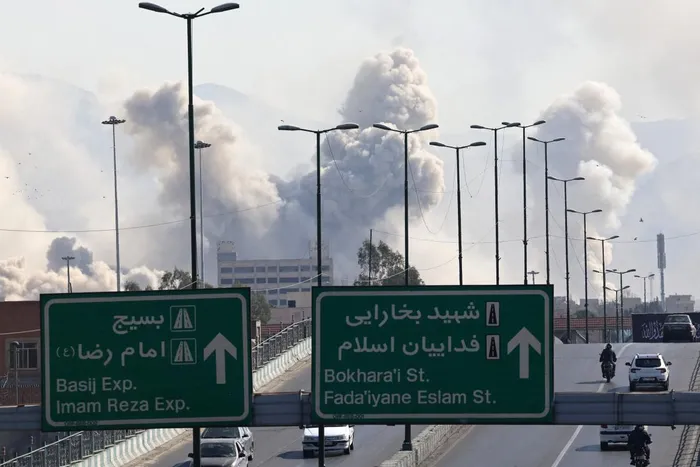
The Middle East conflict will have a significant impact on South Africa's economic outlook.
Image: ATTA KENARE / AFP
The agricultural industry has raised the alarm about the impact of the Gulf war on the export of fresh produce from South Africa to the Middle East.
The USA and Israel's war against Iran is threatening shipping, especially of key commodities such as oil. Economic experts told The Mercury that the expected economic recovery is now under threat.
Economist Dawie Roodt said things have changed quite dramatically for South Africans in just one week. "A week ago, we were talking about a reduction in interest rates, acceleration in economic growth, and the stabilisation of the economy. Things have changed quite dramatically now."
"There is a lot of uncertainty, but this could be a lot worse than what I am describing now. At the moment, what is clear is that interest rate cuts will be on hold for now. I do not think the Reserve Bank will necessarily increase rates, but if things go on like this and the oil price goes up further, then an increase is certainly a possibility. However, rates are not going to be cut; the downward trajectory has been halted for now."
Roodt added that the economic growth prospects were also bleak now, stating: "Economic growth will be worse (far lower) than expected. State revenue is likely to be under pressure, and the state debt trajectory that was supposed to stabilise this year will now only happen a year later. We are certainly in a different world from a week ago."
The Pietermaritzburg Economic Justice and Dignity Group said the Gulf war is a serious problem for food price stabilisation.
The organisation tracks food prices, assessing food affordability for South African households.
Mervyn Abrahams, Director of the Pietermaritzburg Economic Justice and Dignity Group, said Iran is one of the key oil-producing countries in the world, and as we know, oil is crucial in the transportation of goods from the point of production to the point of consumption.
"We had been encouraged by the fuel price drop last month and were hoping that it would result in greater relief for consumers, but the latest developments are not good news at all for South African consumers. Just like we saw in the recent past with the conflict between Russia and Ukraine, there was a rise in food prices because Ukraine is a major producer of agricultural and industrial commodities. We expect a rise in petrol and other items as a result of the US/Israel and Iran conflict," he said.
IOL reported that the Exporters Western Cape (EWC) has also warned that the escalating tensions in the Middle East are starting to create uncertainty for South African exports, particularly those serving the region's fast-growing fresh produce markets. EWC is a non-profit organisation (NGO) established in 1979 to support and promote active, sustainable exporting in the Western Cape.
EWC chairman Terry Gale said the first signs of disruptions are already being felt with rising fuel costs and shipping uncertainty as carriers reassess their services to the region. He said the scale of the disruption is significant.
"The Strait of Hormuz – one of the world's most critical maritime chokepoints – handles roughly 20% of global oil supply and is a key route for trade moving in and out of the Gulf region. As the conflict intensifies, shipping lines have begun suspending services or rerouting vessels, while air cargo operations have also been affected by airspace closures and flight cancellations across parts of the Middle East," Gale said.
The Transnet National Ports Authority (TNPA), South Africa's logistics parastatal, said it was monitoring the impact of this situation.
For more stories from The Mercury, click the link THE MERCURY