

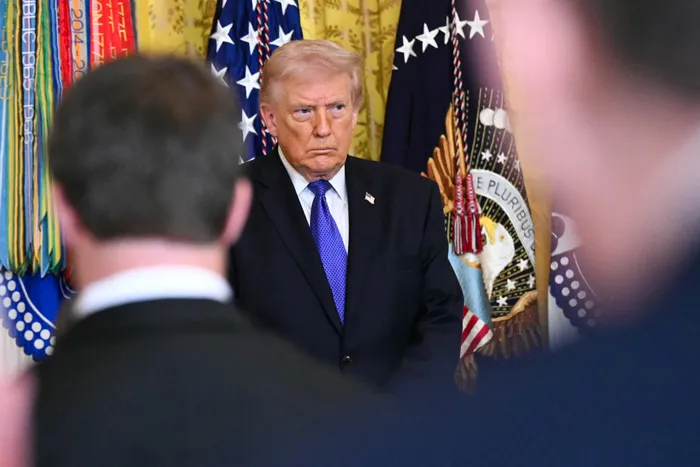
US President Donald Trump has said only Iran's "unconditional surrender" would bring an end to the Middle East war.
Image: SAUL LOEB / AFP
President Donald Trump said Friday that only Iran's "unconditional surrender" would bring an end to the Middle East war, as Tehran was pummelled by some of the heaviest US-Israeli strikes of the week-long conflict.
Now in its seventh day, the war has embroiled nations beyond the region, upended the world's energy and transport sectors, and brought chaos to even usually peaceful areas around the Gulf.
It has spread to Lebanon, whose prime minister warned of an impending humanitarian disaster as the death toll rose and tens of thousands fled heavy Israeli strikes on Beirut's southern suburbs.
Trump, who has given varying reasons for starting the war that killed Iran's supreme leader Ayatollah Ali Khamenei last weekend, promised to help rebuild the country's economy if Tehran installed a new leader "acceptable" to him.
"There will be no deal with Iran except UNCONDITIONAL SURRENDER," Trump wrote on his Truth Social platform.
The main US crude oil price -- already surging with the critical energy waterway the Strait of Hormuz in the Gulf effectively blocked -- soared by 10 percent after Trump's comments.
Israel's military said it had hit more than 400 targets across Iran on Friday.
Several loud explosions sent clouds of black smoke into Tehran's sky, according to AFP journalists who described the day's strikes as the heaviest yet on the capital.
"It's really very scary," a Tehran businessman who gave his first name as Robert told AFP.
"Checkpoints have been put up in place in the city to prevent looting and ensure control," the 60-year-old said as he crossed into Armenia.
Both Israel and the US warned on Friday they were escalating their attacks on Iran.
According to Iran's health ministry, the US and Israeli strikes on the country have killed 926 people.
Iranian government spokesperson Fatemeh Mohajerani said on Friday that 30 percent of the dead were children. AFP could not independently verify either toll.
Mohajerani added that 390 residential units and 528 commercial centres had been struck in Iran. Israel's military insisted it was only striking military targets.
Iran has launched missile and drone attacks at Israel and Gulf states since the war began, with AFP journalists in Tel Aviv reporting hearing several blasts on Friday.
In Israel, at least 10 people have been killed, according to first responders there.
The US military has reported the deaths of six of its personnel.
The conflict has sucked in Lebanon after Tehran's proxy group Hezbollah launched missiles at Israel in response to Khamenei's killing.
Israel's military pounded the country on Friday, including fresh strikes on Beirut's battered southern suburbs, considered a Hezbollah stronghold and home to an estimated 600,000 to 800,000 people.
AFP correspondents saw scenes of panic on Thursday as residents fled en masse after an unprecedented Israeli order to evacuate the suburbs immediately if they wanted to save their lives.
Shadi Sayah, the mayor of Alma al-Shaab village in southern Lebanon, was among those who defied Israeli orders to evacuate.
"Of course I am scared, I am trembling," he told AFP over the phone from the basement of a church, as the sound of strikes got closer.
"It is our right to preserve and remain in our land," he said, adding that "we are pacifists... a danger to no one".
The Norwegian Refugee Council said 300,000 people inside Lebanon had been forced to flee.
Lebanon's Prime Minister Nawaf Salam warned that a "humanitarian disaster is looming".
Lebanon's health ministry said the death toll in the country rose to 217 on Friday, a number that AFP could not independently verify.
Iraq, long a proxy battleground between the US and Iran, has also been dragged into the war. Drones struck an airport and two oil facilities in southern Iraq on Friday, a security official told AFP.
Earlier in the day, oil prices surged after authorities in Iraq's autonomous Kurdistan region said crude production had been halted by an attack on an oilfield.
The United Nations refugee agency said it has declared the crisis a major humanitarian emergency, stressing the need for an immediate response.
The UN's rights chief also called for "impartial investigations" after Iran said a strike on a school that it blamed on the US and Israel killed more than 150 people.
Neither the US nor Israel has said it was behind the strike. US Secretary of State Marco Rubio said Monday that the Pentagon was investigating.
AFP has neither been able to access the site nor obtain independent confirmation of the toll.
The war has also come under increasing scrutiny in Europe, with Spanish Prime Minister Pedro Sanchez calling the US-Israeli strikes an "extraordinary mistake" and "not in accordance with international law".
The war has not spared the rich countries of the Gulf, formerly seen as a tourist hot spot and a rare Middle East safe haven.
Qatar intercepted a drone attack on a US air base on its territory on Friday, while Saudi Arabia said it had destroyed a cruise missile near the central Al-Kharj area.
Thirteen people, seven of them civilians, have been killed in Gulf countries since the war began, including an 11-year-old girl, Elena Abdullah Hussein, in Kuwait.
Two hours before she died, the girl called her father at work to tell him she loved him.
"It was as if she was trying to say goodbye," the girl's father Abdullah Hussein told AFP at the funeral.
The conflict has also expanded as far afield as the Sri Lankan coast, off of which a US submarine torpedoed an Iranian frigate, and Azerbaijan, which threatened retaliation after a drone hit an airport.
Nations have scrambled to repatriate holidaymakers in the Gulf caught up in the fighting, with air traffic severely limited as missiles and drones dominate the skies above the region.