

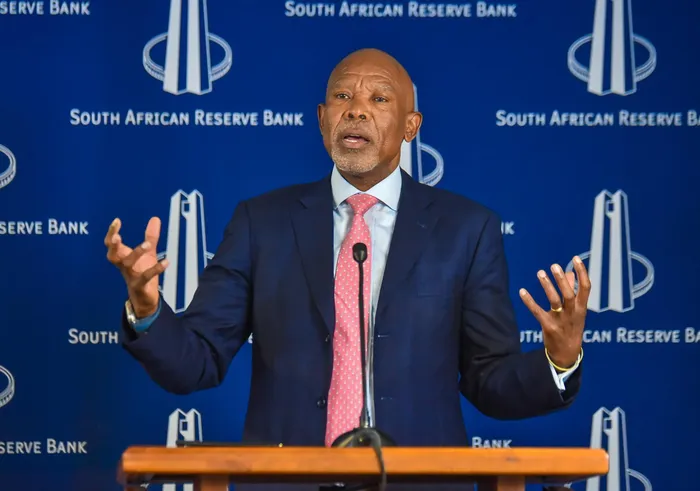
Lesetja Kganyago, Governor of the South African Reserve Bank. Economist Dawie Roodt has suggested that the South African Reserve Bank could increase the interest rate to counteract the steep increase in the oil price.
Image: SARB | Facebook
One of the few tools available to contain a dramatic petrol price increase resulting from the Middle East war is for the South African Reserve Bank (SARB) to raise interest rates.
Economists believe that there is a real possibility the SARB would increase interest rates if the war between the USA, Israel, and Iran persists. They suggest that an interest rate hike would serve to boost the exchange rate of the rand, thereby cushioning against the oil price increase and managing inflation.
They have warned that a full-blown price spike could prove devastating for the country, stating that the government has very few choices in mitigating the increase in energy costs.
Economist Dawie Roodt said one option for South Africa to counteract steep increases in oil prices is to increase interest rates. “There are things we can do, but not very much. As far as oil is concerned, we are price takers. Whatever the international price is, that’s it. If you want it, you have to pay for it; there is not much we can do about it.
“The only viable option is for the Reserve Bank to increase interest rates. If the Reserve Bank increases interest rates, that will support the exchange rate of the rand. The rand will be stronger if interest rates go up. That is something we do have some control over, that is over interest rates and indirectly over the exchange rate of the rand.”
He added there are two effects that are going to push up the overall price: the first is international oil prices, and the second is the exchange rate of the currency.
Roodt said this (interest rate hike) carried serious risk. “Then, of course, you’re going to pay another price (if this route is taken); high interest rates can negatively impact economic growth.”
Economist Dr Sanele Gumede from the University of KwaZulu-Natal said the Middle East is a significant source of oil, and oil prices are going up significantly as a result of the war. “That means across the globe, petrol prices will go up. South Africa is a net importer of oil; we do not have our own, and we will see prices rise significantly.”
He mentioned that to determine the final prices of oil, the government will consider factors including the exchange rate. “The interest rate might go up in direct response to the increase in inflation.”
John Loos, an independent economist, said as the war enters its second week, things look bleak. “There is little obvious that I can think of that the government can do immediately to cushion the blow from such a sudden oil price shock. The pressured state of government finances allows little room for manoeuvre.”
However, in the longer run, focusing on the necessary structural changes for faster economic growth and job creation would significantly help, making the economy more resilient and able to withstand external shocks such as that of an oil price spike.
“As we go into the second week of conflict between Israel, the USA, and Iran in the Middle East — an event that poses major risks to global oil supply — things still look bleak. With oil trading resuming after the weekend, we have seen a significant further jump in oil prices.
“The Brent Crude spot price was around the $107 per barrel mark, up from $92.69 per barrel at the close on Friday, and all indications are that a large domestic fuel price hike is likely in early April,” he said.
For more stories from The Mercury, click the link THE MERCURY