

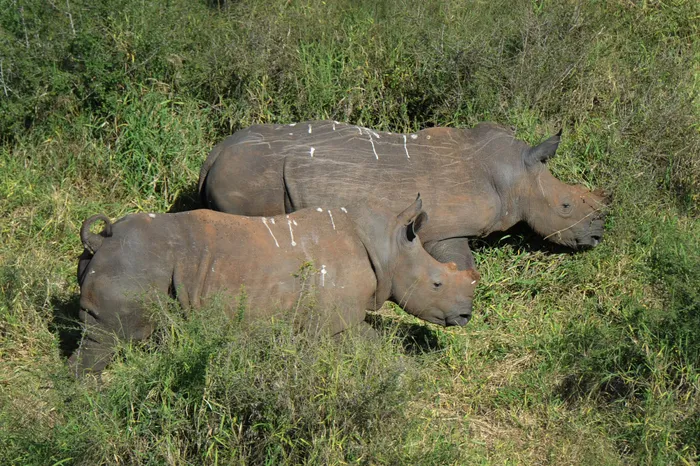
Ezemvelo KZN Wildlife has reached a remarkable milestone with zero rhino poaching incidents in KwaZulu-Natal for January 2026.
Image: Armand Hough / Independent Newspapers
Ezemvelo KZN Wildlife has achieved a historic milestone with zero rhino poaching incidents recorded in KwaZulu-Natal provincial parks in January 2026.
KZN Economic Development, Tourism, and Environmental Affairs (EDTEA) MEC Musa Zondi said this demonstrated that the province is "not merely participating in conservation success, but living in it," marks a decade-best.
The trend is in line with recent poaching stats. According to stats released in February by Environment Minister Willie Aucamp, there was 97 rhinos poached in KZN in 2025, a decline from 232 killed in 2024.
MEC Zondi highlighted that the Hluhluwe-Imfolozi Park's intensive dehorning initiatives have resulted in this significant reduction in poaching activities.
The positive trajectory comes as the entity actively sheds its past reputation for instability and corruption to embrace a new era.
Three years ago, the picture for Ezemvelo was dire. It faced severe governance crises, management instability, and failing public trust as wildlife, most notably lions, escaped from reserves, terrorising surrounding communities.
CEO Sihle Mkhize did not mince words during a media briefing, noting: “You only rebuild when there has been a challenge or a problem.”
He admitted that “it’s an open secret that the organisation has faced some serious challenges, including governance challenges and management instability” and that the institution’s infrastructure was “almost collapsing”.
To address these systemic issues, he said Ezemvelo implemented a rigorous turnaround strategy starting with governance and management stability.
With provincial government assistance, the board focused strictly on its fiduciary responsibilities, allowing management to handle operations.
“It’s not interfering in the operations of the organization; they leave that to the management,” Mkhize explained. All key executive positions, including the CEO and CFO, were filled with permanent appointments to ensure continuity.
Simultaneously, a forensic investigation was launched into corruption allegations, which led to the dismissal of senior executives as part of a “consequence management” drive to “remove the rot”.
Furthermore, the entity introduced compulsory polygraph testing for staff at the front line of conservation.
While there was resistance, Mkhize noted that “the majority of our staff members passed the polygraph testing, but there were few that [were] deceptive”.
Those individuals were promptly moved away from sensitive rhino reserves.
He said Ezemvelo is pivoting toward financial sustainability and deeper community integration. Under its new commercialisation strategy, Ezemvelo is avoiding the pitfalls of full privatisation while actively seeking private sector investment.
MEC Zondi clarified: "Commercialisation does not mean we are throwing out assets. Commercialisation is attracting the skills that we don't have. It means making conservation efficient, bankable, and sustainable."
This strategy includes mandating that entry-level vacancies be filled by neighbouring community members, ensuring locals derive tangible value. Additionally, entrepreneurs are being capacitated to join the supply chain, providing everything from fresh produce for lodges to artisan services for infrastructure maintenance.
To alleviate the financial burden on the institution, a new timeshare-style approach allows private donors to fund the renovation of lodges in exchange for equivalent nights of stay.
In a move toward what Mkhize called “conservation with dignity” a dedicated traditional healers' medicinal plant garden is set to open at the end of March to reduce pressure on wild harvesting and integrate indigenous knowledge systems.
For more stories from The Mercury, click the link THE MERCURY