
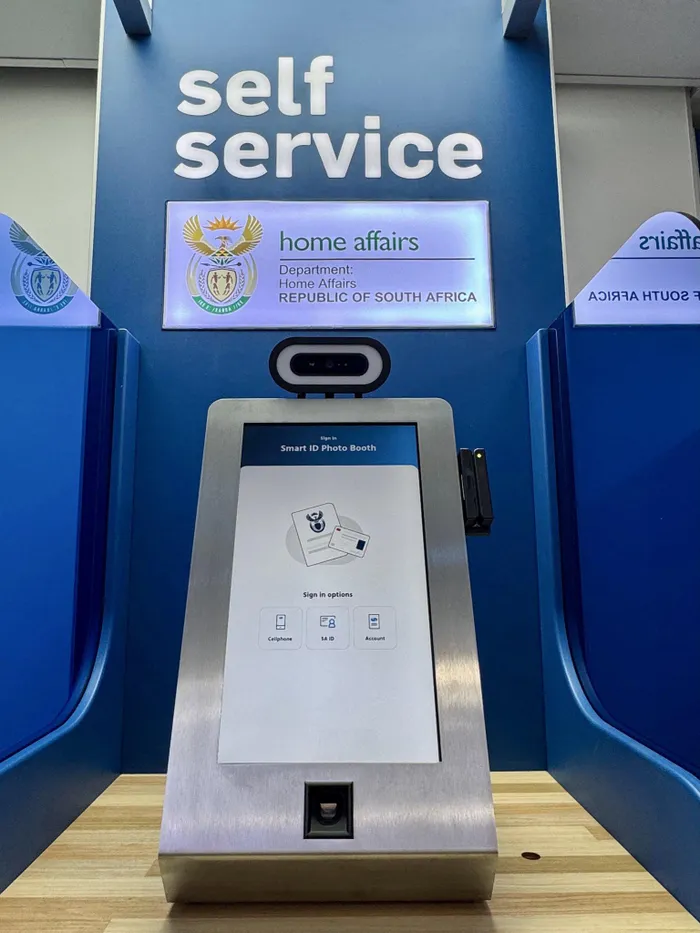
A fierce political clash unfolds as the DA and EFF debate the implications of the new digital Home Affairs system available at select bank branches.
Image: X / @Leon_Schreib
A political battle has erupted between the Democratic Alliance (DA) and the Economic Freedom Fighters (EFF) following the Department of Home Affairs’ decision to rollout a new digital Smart ID and passport system to commercial bank branches.
While branches of some commercial banks already offer some Home Affairs services including Smart ID and passport applications, the new model is fully digitalised.
The Home Affairs ministry explained that under the previous model, banks hosted miniature Home Affairs offices inside their branches, where clients were required to complete applications on the eHomeAffairs platform, make bookings online, and visit the branch primarily for biometric capture.
In contrast, the new model is fully digitalised. Participating banks connect directly to Home Affairs systems through a secure API-based Digital Gateway, allowing applications to be completed within a matter of minutes through the bank’s own service environment, without the need to fill in a single piece of paper.
A select number of Capitec and Standard Bank branches have the new service,
In response to the new model, the EFF expressed deep concern over what they term the privatisation of the infrastructure of citizenship. The party argued that by involving private banks, the DA which currently holds the Home Affairs portfolio, is hollowing out public institutions instead of fixing them.
The party maintains that identity documentation is not a luxury service or commercial product but rather the legal foundation of citizenship. The EFF highlighted that the crisis of documentation in South Africa is severe, with statistics indicating that around 11% of the population, approximately six million individuals lack any formal documentation. This includes 4.4 million South Africans aged 16 and older who do not have identity documents, leaving them effectively stateless and unable to access education, healthcare, or social grants.
The EFF further argued that the policy entrenches inequality, noting that many poor and rural South Africans do not have easy access to bank branches and do not participate in the formal banking system. They also raised alarms regarding data security, suggesting that banks themselves are not immune to corruption, fraud, or data breaches.
The DA hit back, with national spokesperson Karabo Khakhau MP labelling the EFF’s stance as a defence of long queues and identity theft.
According to the DA, the rollout at bank branches is the beginning of the end for the notorious hours-long wait times associated with Home Affairs. Khakhau argued that the transition to Smart IDs is a critical security measure to phase out the often forged Green ID books, which she claimed have allowed for identity impersonation by illegal immigrants.
The DA stated that they reject the EFF’s position, which would result in South Africans continuing to endure long queues, and accused the party of obstructing the transition to secure Smart IDs. The DA also used the opportunity to defend Home Affairs Minister Leon Schreiber’s progress, asserting that the partnership with banks is a pragmatic solution to service delivery backlogs.
The DA maintains that the banking partnership is a necessary modernisation to protect the integrity of South African citizenship.
In KZN the following Capitec branches offer the new service:
Capitec
For more stories from The Mercury, click the link THE MERCURY