

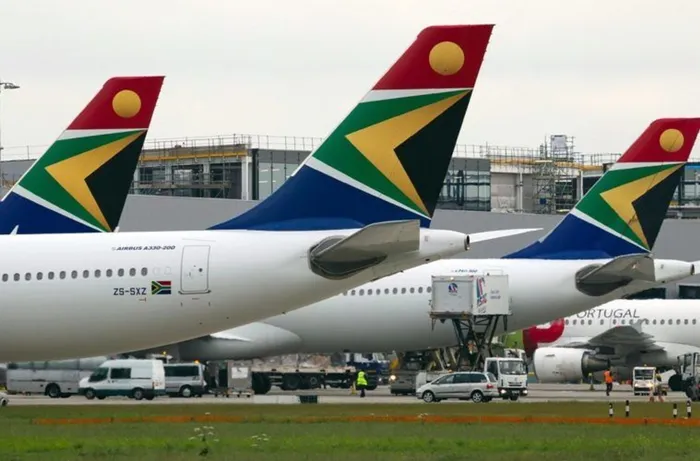
Amid rising tensions in the Middle East, South African Airways reassures passengers of stable fuel supply, highlighting its robust operational strategies and commitment to customer service.
Image: IOL
An aviation expert is calling on the government to put forward a detailed contingency plan to protect the country against global jet fuel shocks amid the Middle East conflict.
He was commenting amid volatile global conditions which pose a serious threat to the country’s supply of jet fuel. The country's reliance on imported jet fuel, combined with a very limited capacity to produce it internally, is a significant threat to air travel, which is the lifeblood of the country’s economy. The jet fuel costs have already had an impact with low-cost carrier FlySafair announcing that it has introduced a temporary fuel surcharge from March 12 to May 12.
Linden Birns, managing director of Plane Talking, expressed serious concern that there is no publicly available government-driven contingency plan to protect against world shocks that cause prices to spike dramatically.
Birns pointed out that the price of jet fuel is so unstable that it can increase multiple times while the shipment is still en route to South Africa.
He told The Mercury that it is concerning that the government has not proposed a contingency plan in case of a crisis.
“There should at least be a plan in place to address this challenge; that states what will happen in case of a challenge,” he said. Birns added that, while not speaking as a risk analyst, certainty around the shipment of jet fuel will be key. “I can't imagine the army does not have a contingency plan for what to do in case of their jets; there should at least be certainty around the shipment of jet fuel,” he added.
“Over the years, we have seen how vulnerable we are to the delicate fuel supply chain. It is disappointing that there has been nothing from the government proactively stating this, especially considering how intrinsic air transport is not just for tourism but for business and moving cargo. A contingency plan should be at the forefront of people’s minds,” said Birns.
Birns outlined the crises that have occurred at the country's major airports, where internal disruptions to infrastructure or adverse weather conditions have disrupted the supply of jet fuel, causing delays.
He stated that the shortage of jet fuel would have severe consequences. He added that the price of fuel can change several times while a fuel tanker is en route to South Africa, reflecting the uncertainty of the situation in the Middle East.
“We also face additional challenges from the floods and riots of 2021 and 2022, which significantly impacted our jet fuel production and refining capability. Currently, there is only one refinery still producing jet fuel, and it is operating at a trickle.
“We rely heavily on imported jet fuel to meet our needs, and we have one of the highest jet fuel costs in the world. This fuel has to be shipped here, and the process becomes more expensive as the fuel is transported around the country and taxed.”
Airlines have expressed concerns regarding jet fuel supply.
FlySafair said that since the Middle East crisis erupted on February 28, it had absorbed steep fuel cost increases to shield passengers from immediate airfare hikes. However, with Jet A1 fuel prices at South African coastal airports rising by approximately 70% in just one week, and no clear end in sight, the airline said it had reached the point where a surcharge was unavoidable.
“We will be specifically itemising this temporary dynamic fuel surcharge on all tickets to ensure fairness and transparency to our customers,” said Kirby Gordon, Chief Marketing Officer at FlySafair.
South African Airways (SAA) said it is closely monitoring developments in the Middle East and their potential impact on global jet fuel supply.
At this stage, it does not anticipate any immediate disruption to its fuel availability. It added that South Africa sources aviation fuel through multiple supply channels, including domestic refining capacity and established import infrastructure, providing resilience against potential regional supply volatility.
For more stories from The Mercury, click the link THE MERCURY