

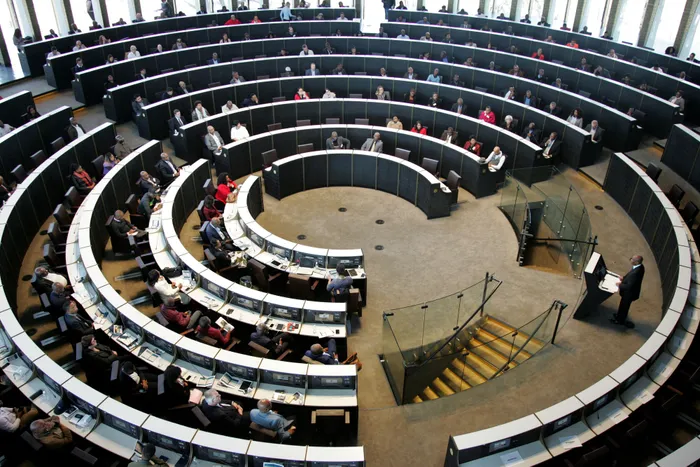
The City of Johannesburg council meeting has failed to adopt the 2025/26 operating adjustment budget after the item did not muster the required 136 votes.
Image: Nhlanhla Phillips / Independent Newspapers
The City of Johannesburg extraordinary council meeting to approve the 2025/26 operating adjustment budget was abandoned after the item failed to get the required votes, forcing deputy mayor and finance MMC Loyiso Masuku to withdraw it.
Following a vote requiring support from at least 136 of the city’s 270 councillors, speaker Margaret Arnolds announced that out of the councillors present, 58 had chosen to abstain while another 67 rejected it outright.
Arnolds said 117 councillors had voted “yes” but this fell short of the 136 needed to carry through the item.
This prompted Masuku to withdraw the matter.
“We would also like to inform Samwu (SA Municipal Workers’ Union) that the EFF, DA and ActionSA rejected their salary and wage (increases) implementation,” she said, sparking loud protestations and accusations of the parties being enemies of the workers.
Much of the opposition to the adjustment budget was due to R1.35 billion overspending on employee-related costs.
GOOD Party councillor and chairperson of the section 79 finance oversight committee Matthew Cook complained about spending on employee-related costs increasing by R1.35bn while the expenditure on contracted services is being reduced by more than R1bn.
EFF councillor Saseka Zitha said employee-related costs would increase by more than R1.3bn and that while workers must always be treated fairly, councillors must also ensure that the city’s wage bill does not grow at the expense of service delivery and infrastructure investment.
DA shadow finance MMC Chris Santana said employee costs have increased by R1.35bn bringing the total wage bill to approximately R23bn, nearly 27% of the municipality’s operating revenue.
ActionSA councillor Steven Nkonyeni told the meeting that municipal-owned entities had increased the wage bill.
“We have a situation whereby executives, for the most part, would earn ten times, 20 times more than your average worker in the city. And yet, there is no way we can justify this bloated staff that we have and exorbitant salaries that we see executives getting,” Nkonyeni said.
Freedom Front Plus councillor Cornelis Boer said in the past six months the city overspent on salaries by R1.2bn.
“This adjustment budget does not serve the purpose for which it is intended to,” he said.
ANC ward 52 councillor Thapelo Radebe mounted a spirited defence of the additional R1.35bn, saying the employee costs are the results of a collective bargaining agreement that has been signed by organised labour and representative local government.
“It is not an adjustment we are just doing because we want to [and] have a high wage bill. But it’s because we value the employees that work within the city,” he said.
Radebe continued: “This adjustment budget is to make sure that our metro police that are on the frontline of our safety, our water technicians, our emergency service personnel are paid and they are paid fairly”.
Masuku added that the issue of the salaries’ overspending was already included in the adjustment budget and clearly articulated.
The meeting was adjourned to March 24 and 25.
loyiso.sidimba@inl.co.za