

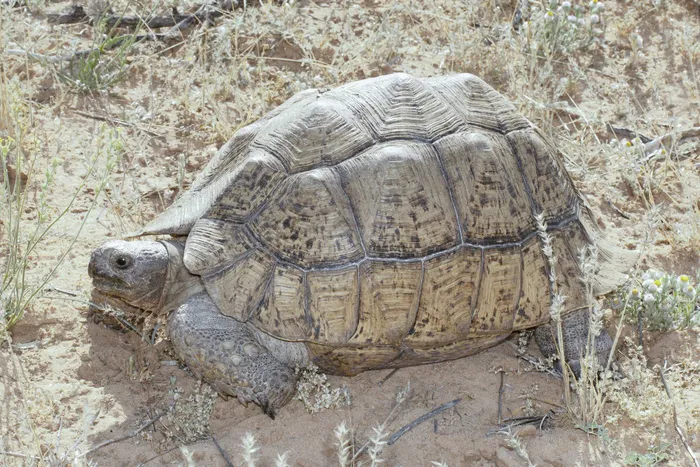
A Leopard Tortoise. Recent arrests in Limpopo shine a light on illegal tortoise trafficking that threatens native species and ecosystems.
Image: Johan Marais
South Africa’s wildlife crime crisis has once again been thrust into the spotlight following recent arrests in Limpopo linked to illegal wildlife trafficking, including the possession of protected tortoises and big cat skins.
Authorities and conservation organisations warn that behind the demand for “cute exotic pets” lies a growing underground trade that is quietly devastating native wildlife populations.
According to the Wildlife Crime Information Network (WCIN), the illegal removal of tortoises from the wild is a “silent crime in the veld” that continues to threaten South Africa’s rich reptile biodiversity.
South Africa is home to more tortoise species than almost any other country in the world, including the Leopard Tortoise, Angulate Tortoise, and the Speckled Padloper.
These slow-moving reptiles play a crucial role in their ecosystems by dispersing seeds and helping maintain vegetation balance.
“Removing them from the wild disrupts these systems and threatens their long-term survival,” WCIN said.
Every year, numerous tortoises are illegally removed from their natural habitat and sold in the pet trade, smuggled across borders, or advertised online.
Investigators say a criminal supply chain often drives the illegal trade.
Poachers collect tortoises from the veld, sometimes in large numbers and sell them to middlemen who move the animals through local pet markets, private collectors, or smuggling routes.
Some tortoises are sold locally as novelty “garden pets”, while others are trafficked internationally to markets in Asia and Europe where exotic reptiles can fetch high prices.
Many animals do not survive the journey.
Wildlife organisations say tortoises are often transported in cruel conditions, crammed into boxes or bags to avoid detection.
“Behind every online advert is a wild tortoise taken from its natural habitat and ripped from the environment it depends on to survive,” WCIN said.
Meanwhile, three suspects were recently arrested during a joint operation targeting wildlife trafficking in Polokwane.
The operation was conducted by the Provincial and Polokwane Stock Theft and Endangered Species (STES) Unit, the Limpopo Department of Economic Development, Environment and Tourism (LEDET), and the Limpopo Pangolin Collective.
Police arrested two suspects, Obed Makoena, 36, and Thabang Kgaphola, 34, near Makro in Polokwane after their vehicle was found carrying 14 protected leopard tortoises without the required permits.
In a separate operation in the Sterpark area, another suspect, Aubrey Mokalapa (32), was arrested after he was found in possession of three leopard skins and one lion skin.
All three suspects appeared before the Polokwane Magistrate’s Court on Wednesday, 11 March 2026.
Each suspect was granted R10 000 bail, and the cases were postponed for further investigation.
Limpopo’s Provincial Police Commissioner, Lieutenant General Thembi Hadebe, welcomed the collaborative efforts that led to the arrests.
WCIN is urging members of the public to report suspected wildlife crimes.
Keeping, selling, or transporting indigenous wildlife without the required permits is illegal in South Africa.
The organisation also warned that releasing unwanted tortoises into the wild is illegal and dangerous, as relocated animals often fail to survive and may spread disease to local wildlife populations.
Members of the public who suspect illegal wildlife activity are encouraged to report it via the WCIN hotline on 079 643 9556 or email report@wcin.org.za
“Protecting our precious wildlife is a shared responsibility,” the organisation said.
For more stories from The Mercury, click the link THE MERCURY