

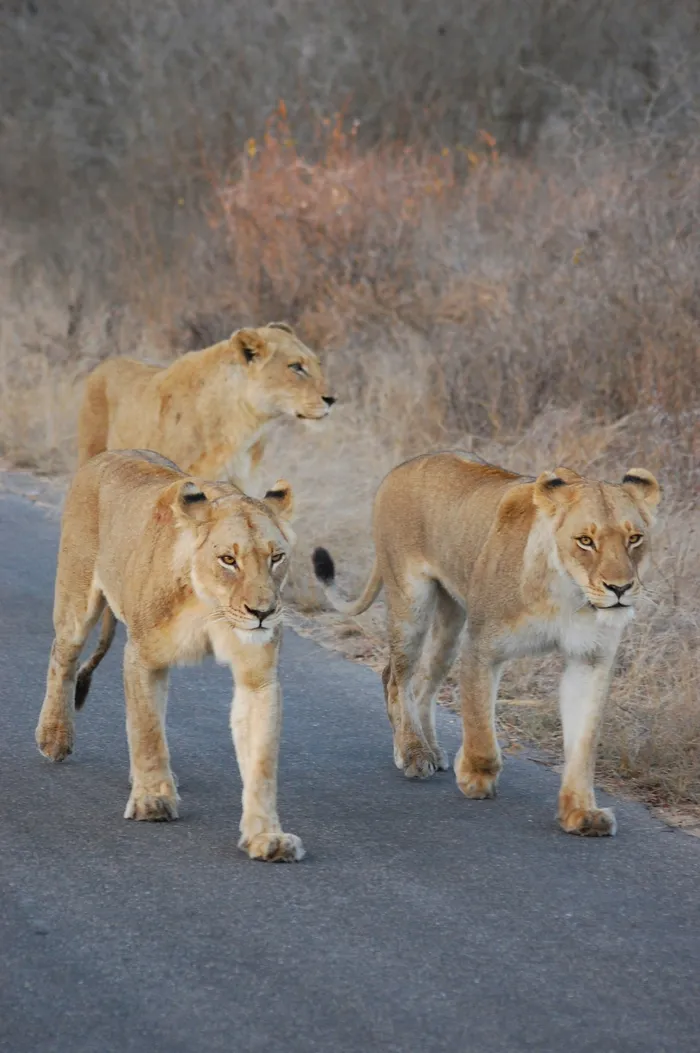
A pride of lionesses on the road at Kruger National Park.
Image: Unsplash
A new lion population survey in the northern reaches of the Kruger National Park has revealed a worrying decline in numbers, with conservationists warning that poaching and environmental pressures are taking a growing toll on one of southern Africa’s most important lion strongholds.
The Greater Limpopo Transfrontier Conservation Area, which spans South Africa, Mozambique, and Zimbabwe, remains a critical refuge for African lions (Panthera leo). At its core lies the Kruger National Park, long regarded as a key source population for surrounding reserves. However, recent findings suggest that this status is under increasing threat.
The latest data builds on earlier surveys, highlighting a sharp drop in lion numbers over time. In 2005, the park-wide population was estimated at 1,803 individuals, including 455 lions in the northern regions. By 2025, numbers in the Nxanatseni north and south areas had fallen dramatically to an estimated 179 individuals.
“With that survey now a decade old and reports of increased poaching, particularly in the northern Kruger National Park, concerns about the current status of lions in the region are justified,” the report noted.
In response to these concerns, the Endangered Wildlife Trust (EWT), in partnership with South African National Parks (SANParks) and the Lion Recovery Fund, conducted a focused survey in 2024 across the northern half of the park.
A previous three-month survey in 2023 estimated just 105 lions in the Nxanatseni north region, using search encounters and camera traps. The 2024 study, conducted between July and September in Nxanatseni south, applied spatial capture-recapture methods, a more rigorous approach that identifies individual lions through unique whisker spot patterns.
“Spatial capture-recapture entails taking photographs of a lion’s whisker spots to identify individuals. Some individuals are seen more than once, thus the recapture of their information to avoid counting the same lion twice,” the report explained.
Field teams from the EWT’s Carnivore Conservation programme covered an extensive 10,446 km over three months, recording 182 detections of 74 individual lions, 22 males and 52 females. Cubs under one year old were excluded due to high mortality rates.
From this dataset, researchers estimated that 144 lions inhabit the Nxanatseni south area, equating to a density of 3.5 lions per 100 km².
The findings also revealed spatial variation in lion density across the landscape. “The survey again found that lion density decreased the further carnivores are away from water,” the report stated. Areas with productive soils and abundant herbivore prey supported higher lion densities, while regions dominated by mopane woodlands and those closer to human settlements showed lower numbers.
Out of 247 lion detections during the study, only 182 could be confidently identified, with 65 remaining unconfirmed due to poor image quality.
Environmental and human factors appear to be compounding the decline. Lower densities were observed in western sections of the park, where “mopane woodlands, proximity to communities, and conflict with poaching may limit lion populations.” Other areas with intermediate densities were constrained by “poor soils, low rainfall, and the hilly terrain.”
Although poaching incidents were not formally recorded during the study period, evidence of the threat was clear. “Poached lions were found on the western boundary of the Park,” the report confirmed.
The authors warned that the trends are deeply concerning given Kruger’s importance to regional lion conservation.
“The observations are concerning given the conservation importance of the Kruger lion population,” the report stated.
To address the crisis, conservationists are calling for stronger interventions, including deeper engagement with local communities and traditional medicine users, as well as tougher law enforcement measures. Proposed steps include granting rangers arresting powers and introducing harsher penalties for wildlife crimes.
At the same time, researchers emphasised the need for further investigation into ecological factors. “More research is needed to determine the effect of water management in conservation areas, and the effect of the increasing human presence along the boundary of the Kruger National Park on the species,” the report stated.
For more stories from The Mercury, click the link THE MERCURY