

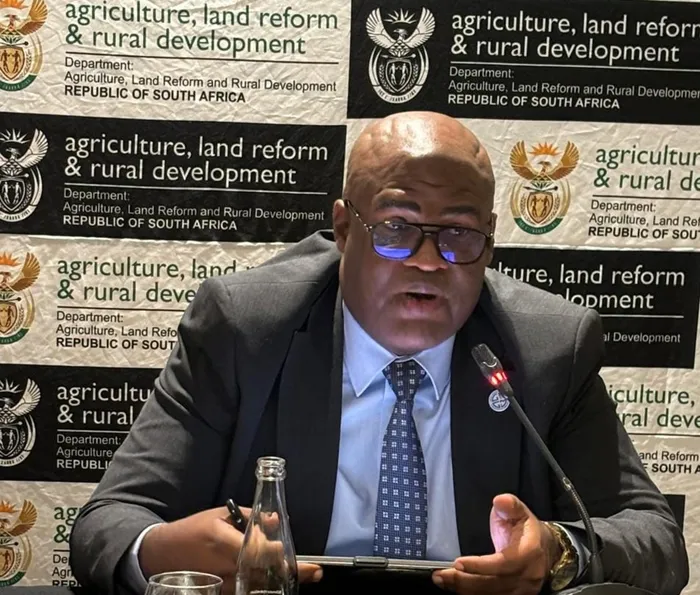
Land Reform and Rural Development Minister Mzwanele Nyhontso has announced the dissolution of the KwaZulu-Natal Ingonyama Trust Board (ITB).
Image: Independent Media Archives
Land Reform and Rural Development Minister Mzwanele Nyhontso has dissolved the Ingonyama Trust Board following a “governance crisis”, appointing an administrator to ensure effective land management and community interests are safeguarded.
The ministry said in a statement that the decision follows the resignation of several board members before their terms had expired. This left the Board with only four serving members, in addition to the King Misuzulu kaZwelithini, who serves as chairperson under the KwaZulu-Natal Ingonyama Trust Act.
The king is the sole trustee of the Ingonyama Trust Board, which administers nearly 3 million hectares of land in KwaZulu-Natal.
According to the Minister, the Administrative Regulations of the Act require five members to constitute a quorum for Board meetings. While the regulations allow for a second meeting to proceed without a quorum if the first fails, the Minister determined that this "stop-gap" approach was no longer viable.
Nyhontso, the ministry said, concluded that the current composition has created a governance position that is "no longer sustainable" for effective administration. He cited practical difficulties in maintaining stability and the urgent need to ensure the lawful management of Trust land for the benefit of the communities involved.
To maintain operational continuity, an administrator will be designated under section 49(3) of the Public Finance Management Act (PFMA). This official will oversee the day-to-day operational administration of the Trust.
The minister emphasised that this intervention is necessary to protect the continuity of the lawful administration of the Trust, safeguard the interests of the communities for whom the land is held, and maintain administrative stability while the Board is reconstituted through due process.
Premier of KwaZulu-Natal, Thamsanqa Ntuli, said he had noted the dissolution and confirmed that the Minister consulted with both his office and the king, before making the final determination.
Ntuli described the Ingonyama Trust as a "cornerstone of KwaZulu-Natal’s rural economy" and an essential instrument for the 7th Administration’s goals of economic growth and poverty reduction.
"We remain committed, as government, to supporting initiatives that empower rural communities, improve land administration systems, and accelerate development in areas under the jurisdiction of the Trust," said Ntuli.
The Department of Land Reform and Rural Development stated that the process to reconstitute the Board will follow the legal requirements of the Act and include all necessary consultations. Further details on the implementation of these transitional arrangements are expected to be communicated in due course.
However in a scathing rebuttal, the Ingonyama Trust Board (ITB) placed on record that the Minister’s announced course of action is "unlawful, ultra vires and inconsistent" with the KwaZulu-Natal Ingonyama Trust Act and the PFMA.
The Board argued that the Minister’s move is "irrational" because the Act expressly provides that a vacancy does not prevent the Board from carrying out its functions. "The lawful response to resignation is therefore the filling of vacancies through the prescribed statutory process, not the displacement of the Board through an extra-statutory arrangement," the ITB stated.
The Board further challenged the Minister’s claim that a lack of a quorum rendered the body inoperative. Highlighting Regulation 15 of the Administrative Regulations, the ITB noted that a continuity mechanism exists where, if a first meeting is not quorate, a second meeting may be convened where those present form a valid quorum.
The Board maintained that "the regulations thus create an express continuity mechanism and do not support the conclusion that the Board becomes legally inoperative merely because the first meeting is not quorate."
Regarding the appointment of an Administrator under section 49(3) of the PFMA, the ITB contended that the Minister does not have the authority to act alone in this capacity.
"On its face, section 49(3) does not authorise the Minister, acting alone, to designate an Administrator for day-to-day operational administration," the Board noted, adding that the departures of four members since September 2024 for reasons including personal development and professional opportunities, should not be "misconstrued as dissolving the Board or extinguishing its legal standing."
The Board said it is obtaining legal advice and reserves all rights to challenge the intervention through the courts.
For more stories from The Mercury, click the link THE MERCURY