

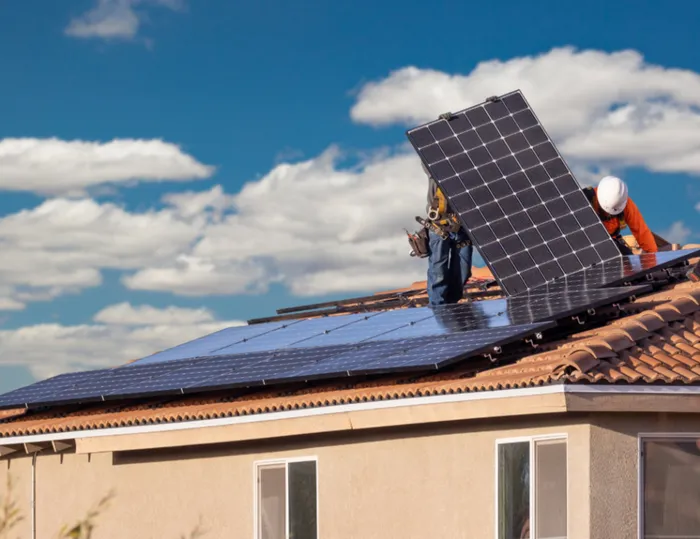
Power utility Eskom has announced its free registration deal for home solar panel systems ends on March 31.
Image: Supplied
The clock is ticking for South African households to formalise their solar panel setups as a critical administrative deadline approaches.
With the March 31, 2026, cut-off just days away for its registration deal, Eskom is ramping up its “act now, stay legal” campaign.
However, the push has ignited a fierce debate over what critics call regulatory overreach, with watchdogs warning that homeowners are being bullied into unnecessary red tape.
The power utility states that under Schedule 2 of the Electricity Regulation Act, all systems under 100 kilovolt-amperes (kVA)must be registered with the network service provider - Eskom or municipalities - and comply with grid code requirements.
Eskom is currently making an aggressive push to register Eskom household customer residential solar PV and battery energy storage systems under 50kVA.
To sweeten the deal, the utility is waiving all registration and connection fees for systems up to 50kVA, a benefit they value at up to R10,000, which includes the installation of a free smart meter until March 31,2026. This financial window is only open until the end of the month, after which the utility suggests that non-compliant users could face steeper hurdles or even disconnection.
To register, homeowners must obtain a valid Certificate of Compliance (CoC) for electrical wiring and an NRS097-2-1 inverter type test certificate. While the process previously required a professional engineer to sign off, Eskom has since lowered the barrier, stating that a registered person from the Department of Employment and Labour is now sufficient to approve the installation.
“Registration of an SSEG system is commonplace worldwide and helps ensure a home or business is safe, technicians are protected when working on the network, and the community electricity supply remains reliable,” Eskom stated in a recent update.
However, the Organisation Undoing Tax Abuse (OUTA) has raised serious concerns about parallel compliance processes.
OUTA CEO Wayne Duvenage argues that Eskom and certain municipalities are introducing demands that duplicate existing legal requirements, effectively forcing citizens to comply twice for the same system.
“Households are being asked to comply twice for the same system. That is not regulation. That is overreach,” Duvenage said.
He added that South Africa already has a clear legal framework for electrical installations, and that any additional requirements must align with national law rather than override it. “Eskom cannot rewrite the rules because it suits them. The law is clear, and it must be applied consistently,” Duvenage said.
The dispute centres largely on systems installed “behind the meter” that do not feed electricity back into the national grid. While Eskom insists these must be registered for safety and oversight, OUTA maintains that a valid CoC is lawful proof of safety.
The watchdog has suggested that if a system does not export power and the homeowner has a valid certificate from a registered electrician, they may choose to forgo the Eskom registration.
“A valid Certificate of Compliance is lawful proof that your system meets all required safety and technical standards. Eskom or municipal registration processes fall outside national legal requirements,” OUTA stated in its guidance to consumers.
While Eskom says it is working with the South African Bureau of Standards and industry bodies to harmonise these rules, the immediate reality for many is a mix of fragmented regulations and inconsistent enforcement. OUTA has gone as far as recommending that any law-abiding homeowner who receives a formal notice of disconnection should seek legal advice to oppose enforcement that they believe is not supported by law.
For more stories from The Mercury, click the link THE MERCURY