

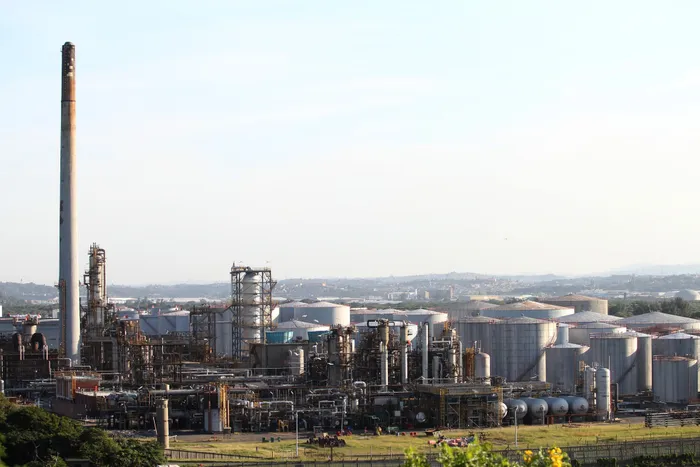
The Central Energy Fund is preparing a report on the future of the Sapref refinery in Durban.
Image: Doctor Ngcobo/Independent Newspapers
As the deadline looms for the Central Energy Fund’s (CEF) study into the future of the Sapref refinery in Durban, Parliament’s Portfolio Committee on Mineral and Petroleum Resources says it has not received any recent update on whether the March 31 target will be met. The committee, chaired by Mikateko Mahlaule, confirmed that its last formal engagement with the CEF took place during an oversight visit in January this year.
“The Committee recently engaged the CEF during its oversight visit in January 2026 and is scheduled to adopt the oversight report next Tuesday. Since that visit, the Committee has not engaged the CEF and therefore does not have the latest update regarding the aforementioned deadline,” Mahlaule said.
The Sapref refinery, located in Durban, has become central to discussions about South Africa’s fuel security, particularly amid ongoing volatility in global oil prices.
Despite the current oil price pressures, the committee stressed that the debate over reviving refining capacity goes beyond short-term market fluctuations.
“The issue extends beyond oil prices. Energy security poses a broader and more significant threat to the country. The Committee is of the view that the refinery is now more necessary than ever to increase domestic capacity and strengthen energy security,” Mahlaule said.
The committee indicated that a more comprehensive update from the CEF is expected in the coming months. “In May 2026, the Committee will engage the CEF Group on its plans and budget for the 2026/27 financial year. SAPREF will be central to these discussions,” Mahlaule said.
This engagement is expected to provide clarity on both the Sapref study and broader plans to transition toward cleaner fuels while restoring refining capacity. Mineral and Petroleum Resources Minister Gwede Mantashe has also weighed in on the urgency of reviving local refineries.
Speaking at the Southern African Oil and Gas Conference last week, Mantashe warned that delays in restoring refining capacity could have severe consequences for fuel prices and energy stability. “This highlights the urgency of restoring our refining capacity. Many major companies pulled out of refining. For SAPREF, SAF, and PetroSA, it’s urgent to have those refineries working to add to what we have in NATREF and in the Astron Refinery here in Cape Town. If we don’t do that, we are going to have the price (go up) uncontrollably,” he said.
Mantashe added that regulatory and legal hurdles are slowing down the development of the country’s oil and gas potential. “The prescription from the environmental lobbyists is quite clearly a liability for us in South Africa. We have the potential to exploit oil; we have the potential to exploit gas, but for every oil and gas project, we end up in court.”
He argued that oil and gas could become a key driver of economic growth if these constraints are addressed. Independent economic analyst Bonke Dumisa said fragmentation in the management of refinery-related entities has historically created opportunities for corruption.
“It is an undeniable fact that the multiplicity of structures and organisations involved in oil refineries in South Africa only served those who were looters. Putting all these together will reduce the scope of looting,” Dumisa said.
He also defended some of Mantashe’s remarks, noting that public opposition to energy projects can sometimes hinder development.
“Minister Gwede Mantashe likes ‘shooting from the hip’; hence, he is easily misunderstood even when he makes a lot of sense. Minister Mantashe is correct about the ‘NIMBYs’ in South Africa. They just oppose anything and everything that involves potential explorations without actually doing any cost-benefit analysis,” he said.
Dumisa added that prolonged legal battles over energy projects risk depriving the country of economic opportunities tied to oil and gas discoveries.
For more stories from The Mercury, click the link THE MERCURY