

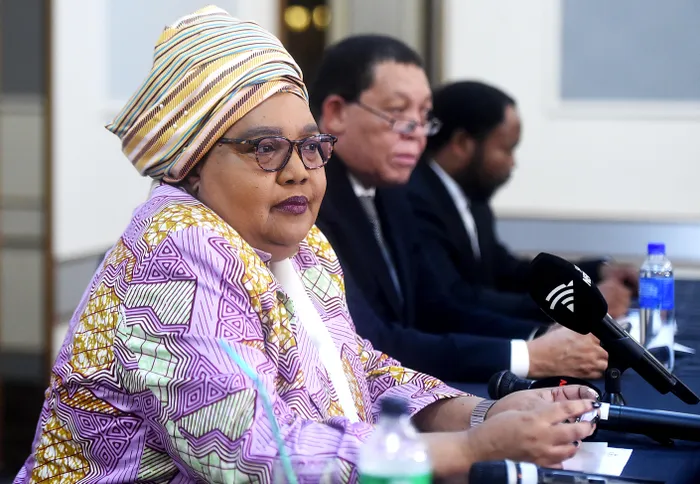
Chairperson of the CRL Rights Commission Thoko Mkhwanazi-Xaluva unveiled members of the Section 22 Committee during a press briefing held at the Parltonian Hotel this week.
Image: Itumeleng English/ Independent Newspapers
The CRL Rights Commission has announced it is moving into the next phase of its Section 22 process, despite facing legal challenges and concerns that the move is constitutionally questionable.
At a press conference on Wednesday, March 25, the Commission outlined a timeline that includes nationwide consultations within the Christian sector and the creation of a Section 22 Committee for African Traditional Religion.
CRL chairperson Thoko Mkhwanazi-Xaluva reiterated that the commission will continue its work unless the courts direct otherwise, dismissing suggestions that it has acted outside its mandate.
The commission’s commitment to its "consultative" process comes as the South African Church Defenders (SACD) are challenging the lawfulness of the Section 22 Committee before the high court. The SACD is seeking an interdict to stop the commission’s investigations and has called for the removal of Mkhwanazi-Xaluva, citing poor performance.
The Post reported that the South African Muslim Network has expressed its opposition to the proposed section 22 committee and the South African Hindu Maha Sabha (SAHMS) raised concerns regarding the process adopted to establish the committee.
Mkhwanazi-Xaluva unveiled the members of the new Section 22 Committee at the briefing.Dr John Maloma was named as the chair of the committee, joined by Lizwi Ncwane as his deputy.
“The Constitution does not allow you to abuse other people. It does not allow you to deceive people,” Mkhwanazi-Xaluva told the media. “It is not a free-for-all in this country, and we are saying it is never going to be a free-for-all.”
Freedom of Religion SA (FOR SA) executive director Michael Swain argues that the CRL is accelerating a process that remains substantively unchanged despite serious legal concerns.
“The issue, ultimately, is not whether the CRL can proceed. The issue is whether what it is doing is lawful,” says Swain. “The CRL should press pause while the courts consider this matter.”
While the CRL describes the framework as "voluntary self-regulation", FOR SA claims the Commission's own documentation (Section 2.3) reveals a predetermined plan for a legislative framework. This includes the registration of religious leaders and institutions, which critics say would effectively amount to state regulation.
FOR SA maintains that South Africa already has sufficient laws to address abuse and fraud. They point to the fact that the faith sector has already developed its own voluntary "Code of Conduct" through bodies like SACOFF, which represents over 10 million Christians, a development they claim the CRL has failed to meaningfully recognize.
The escalating tension has prompted an intervention from the Speaker of the National Assembly, Thoko Didiza.
In a statement, the Speaker noted "escalating tensions" and concerns regarding the inclusivity and constitutionality of the Section 22 Committee.
While acknowledging the CRL's mandate as a Chapter 9 institution, the Speaker has requested Dr. Zweli Mkhize, chairperson of the Portfolio Committee on COGTA, to "urgently intensify engagements" with all stakeholders.
The Speaker emphasised that while the state must protect citizens from harm, it must also safeguard the constitutional guarantee of religious freedom.
For more stories from The Mercury, click the link THE MERCURY