

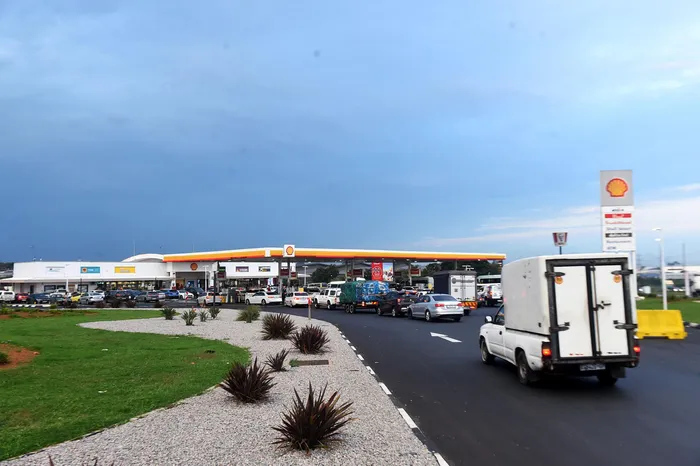
Motorists rush to fill tanks at a Shell garage along the M2 before fuel price increases. This follows the ongoing war in the Middle East sent prices soaring.
Image: Itumeleng English/ Independent Newspapers
Finance Minister Enoch Godongwana and Mineral and Petroleum Resources Minister Gwede Mantashe have explained the measures being taken by government to cushion the blow of rising fuel prices due to the escalation of the Middle East conflict.
In a joint statement late on Tuesday, the ministers said consultations have been held between the National Treasury and the Department of Mineral and Petroleum Resources (DMPR) to explore measures to provide short-term relief to consumers, while maintaining a stable and sustainable fuel supply system.
Among the measures announced is a temporary reduction in the general fuel levy. The DMPR announced on Tuesday that both grades of petrol will see a price increase of R3.06 per litre, while diesel will increase by between R7.37 (500ppm) and R7.51 (50ppm). Illuminating paraffin will see a price hike of R11.67 per litre
The ministers again reassured there is sufficient fuel supply in the country to meet current and projected demand.
“Reports of shortages in certain areas are largely due to localised distribution and logistical challenges driven by panic buying rather than a lack of national fuel stocks and these are expected to self-correct in the next coming days. Motorists and businesses are encouraged to purchase fuel responsibly and avoid unnecessary stockpiling.”
There are two phases announced to deal with the fuel prices in a bid to support households and key sectors of the economy:
Phase 1
The Minister of Finance proposes that the general fuel levy is temporarily reduced by R3 per litre from Wednesday 1 April 2026 to Tuesday 5 May 2026. This will reduce the general fuel levy for petrol from R4.10 per litre to R1.10 per litre and reduce the general fuel levy for diesel from R3.93 per litre to R0.93 per litre for one month. These amounts exclude other levies such as the Road Accident Fund levy and the Carbon Fuel Levy.
It is estimated that the partial reduction in the fuel levy will cost around R6 billion in foregone tax revenue for the one-month period. The relief measure will be re-evaluated on a monthly basis for the following two months.
The ministers said the relief measure is designed to be fiscally neutral, and the government will implement mechanisms to recoup the foregone revenue within the fiscal framework approved during the 2026 Budget.
Phase 2
The Minister of Mineral and Petroleum Resources will continue work to review fuel pricing over the medium term. Work is underway on a broader package of measures to support households and key sectors of the economy. Further details on additional support measures will be announced in due course.
For more stories from The Mercury, click the link THE MERCURY