

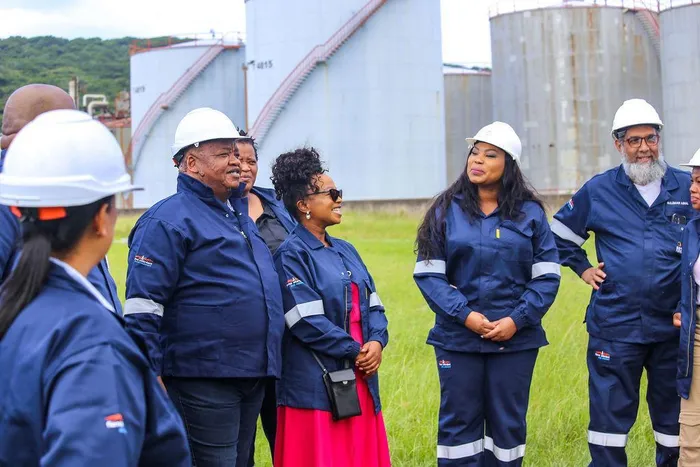
eThekwini City Manager Musa Mbhele and the Deputy Minister of Mineral and Petroleum Resources Phumzile Mgcina, visited the former SAPREF refinery to plan its revival as the SANPC Refinery.
Image: eThekwini Municipality
The rebuilding of the former SAPREF refinery in Durban will take close to eight years and cost more than R100 billion.
The government revealed that work to rebuild the plant, which closed down in 2022 due to extensive flood damage, will soon get underway. However environmentalists have vowed to fight the move, arguing that residents had endured several incidents over the years and did not want a refinery in the area.
Musa Mbhele, eThekwini City manager, alongside Deputy Minister of Mineral and Petroleum Resources, Phumzile Mgcina, conducted an oversight visit to the former SAPREF Refinery in Prospecton this week.
In a statement, eThekwini Municipality said the facility, once a cornerstone of the country’s fuel production, is now rebranded as the South African National Petroleum Company (SANPC) Refinery.
It is being repositioned as a key driver of industrial renewal.
“This is more than a technical inspection; it signals strong alignment between national and local government,” said Mgcina. “As a department, we are trying to revive it. We are very excited about the development this will bring and the opportunities for young people. This plant will be rebuilt from scratch, which will attract a lot of investment and opportunities for young people. We are working together with eThekwini and the MEC for economic development in the province.”
Mbhele said the SANPC Refinery is a critical asset for both the municipal and national economy. He stated that the investment would run to billions of rand. “They (government) will be spending more than R100 billion in the next 5 to 8 years resuscitating the refinery to ensure that our country has energy security and is able to create jobs.
“There will be thousands of jobs created, which is really a very good story for the people of the south of our city. We calculated all the investments that are about to be unleashed in that area and came to a conclusion that about R250 billion will be triggered as investment in this area. We appeal to all the environmental lobby groups that are operating in the South to engage so that we can deal with the unemployment in our country. It’s an opportunity to address that once and for all through opportunities of this nature.”
In a statement, the municipality said the refinery’s return to operation is expected to unlock strategic crude supply opportunities aligned with BRICS partnerships. It stated that by leveraging South Africa’s membership, the facility aims to secure more reliable and diversified energy sources, contributing to greater fuel price stability. In the context of ongoing global geopolitical uncertainty, this approach supports a more resilient and self-reliant energy framework.
The restoration project, added the statement, is projected to deliver significant economic benefits, including approximately 12 500 construction jobs and 2 850 permanent positions.
However Desmond D’Sa, of the South Durban Community Environmental Alliance (SDCEA), said the community does not want the refinery close to them due to the environmental impact it may cause and the trauma they endured in the past due to fires and other incidents.
He said rebuilding the refinery runs counter to what the country needs, and the trend around the world is to avoid investing in such projects.
The Durban South community has always expressed displeasure about the presence of this and other similar refineries, citing health risks due to exposure to chemicals emitted during the process. “Last year, we protested, and we are hoping to hold another massive protest going to the city hall against this,” said D’Sa. “The people do not want this here,” he said.
He said the rebuilding of the refinery contradicts the direction the country should be going, which is to reduce pollution.
“Climate change is real. They (the municipality and the government) are facing lawsuits as a result of the damage caused by climate change, the floods that damaged businesses in the south of the city. Now, why would they go and build a refinery?” he asked.
He added that he believed the proposal to rebuild the refinery was an electioneering gimmick, pointing out that the costs to build such a facility are out of reach for the government and that there will be difficulties finding investors who would want to put money into such a project.
“That refinery will cost a lot of money to build. There is no one who is building refineries at the moment, not to mention the fact that crude oil is a product that could soon run out. So who would be building a refinery under those conditions?” he said.
He questioned the involvement of the municipality in the issue, pointing out that the municipality is battling to deliver basic services to the community and should not involve itself with running an expensive asset like a refinery.
Mafika Mndebele, the chairperson of the Economic Development Portfolio Committee, said while they have not been briefed...at face value, the proposed investment of R250 billion and the potential for thousands of jobs is a significant opportunity, particularly for KZN.
“It has the potential to contribute meaningfully to industrialisation, local economic development, and energy security. However, the committee would be interested in interrogating a few critical areas, including the funding model and ownership structure of the project, the timelines for reconstruction and operationalisation, the extent of localisation and participation of local SMMEs, the skills development and absorption of local labour, and environmental compliance and transition considerations within the broader energy mix,” he said.
For more stories from The Mercury, click the link THE MERCURY