

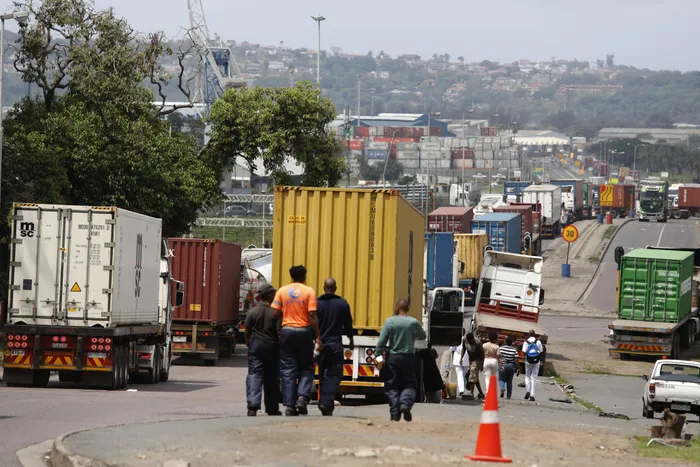
Trucks on Bayhead Road in Durban. The freight industry says the diesel price increase will have a significant impact on the sector.
Image: Doctor Ngcobo / Independent Newspapers
South Africa’s latest fuel price increases, which took effect on 1 April, are expected to accelerate cost pressures across the supply chain, with freight operators warning that transport has become a primary channel through which inflation is transmitted into the broader economy.
The Department of Mineral and Petroleum Resources confirmed the adjustments following a review period marked by higher global oil prices and a weaker rand.
A temporary R3.00 per litre reduction in the general fuel levy, implemented jointly with National Treasury, came into effect alongside the increases and will remain in place until 5 May. However, industry players say the relief has been overtaken by the scale of the adjustments.
Petrol rose by R3.06 per litre, while diesel increases were significantly higher, with 0.05% diesel up R7.37 per litre and 0.005% diesel up R7.51 per litre.
Industry body the South African Freight and Logistics Association (SAFLA) said the timing and magnitude of the increases have immediate implications for freight pricing and route viability.
Chief executive Dave Logan said fuel volatility continues to expose weaknesses in the country’s logistics system, particularly where inefficiencies compound operating costs.
“When our corridors stall, the cost doesn’t just show up in delayed containers, it shows up in litres burned, in higher transport inflation, and in reduced competitiveness for South African trade,” Logan said.
SAFLA noted that inland diesel pricing already demonstrate how quickly input costs have escalated. Using March wholesale benchmarks, diesel (0.005%) in Gauteng stood at R18.60 per litre. With the April adjustment applied, that figure rises to an estimated R26.11 per litre.
The association said this level of movement forces operators to reprice contracts almost immediately, particularly in long-haul freight where fuel accounts for a substantial share of operating expenditure.
The Road Freight Association (RFA) said the impact is already being felt across operators’ balance sheets, warning that diesel cost pressures have shifted the sector into a high-risk operating environment.
CEO Gavin Kelly said the latest adjustment represents a 32.5% increase in a key cost input, noting that fuel typically accounts for between 35% and 55% of total operating costs depending on vehicle type, route conditions and congestion.
“This is an increase of 32.5% of a basic cost input that is between 35% and 55% of total operating costs,” Kelly said.
He warned that operators are now facing difficult decisions on pricing and cash flow, particularly where existing contracts do not allow for rapid tariff adjustments.
“Transporters are in the business of making money, not in the business of making a loss,” he said, adding that there is no certainty that clients will absorb higher transport charges.
The association said liquidity pressures are emerging as a key constraint, with operators increasingly reliant on short-term credit or supplier arrangements to manage daily fuel requirements.
While government’s temporary fuel levy reduction has provided some cushioning, industry bodies say it is insufficient to offset the broader spike in international oil prices and currency depreciation.
SAFLA said the situation highlights the need for structural interventions in freight corridors, including reduced border delays, streamlined permit systems and improved coordination between state agencies responsible for trade facilitation.
It said inefficiencies in logistics networks effectively amplify fuel consumption by increasing idle time, congestion delays and route unpredictability.
For more stories from The Mercury, click the link THE MERCURY