

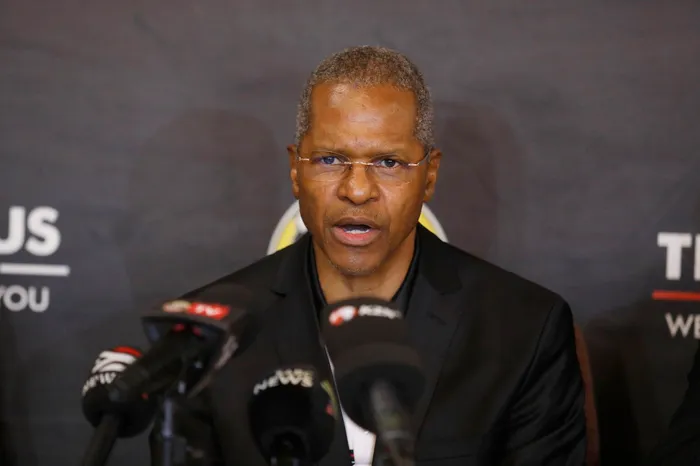
Co-operative-Governance and Traditional Affairs Minister Velenkosini Hlabisa said the South African government is set to review non-viable municipalities, aiming for significant changes by the 2031 local government elections.
Image: Doctor Ngcobo/ Independent Newspapers
Non-viable municipalities across the country could be phased out within the next five years as the government looks to overhaul the poor state of service delivery.
Cooperative Governance and Traditional Affairs Minister Velenkosini Hlabisa said the government is concerned about municipalities that exist but serve no purpose and wants a review of this situation by the 2031 local government elections. The South African Local Government Association (Salga) called for careful consideration of the challenges faced by municipalities, stating that their issues are historical, complex, and require careful engagement.
Hlabisa met with journalists and editors of the Independent Media group in Durban yesterday, where he spoke about the government's work, including the state of municipalities. He touched on the issues raised in the local government White Paper. The White Paper is a government review document that seeks to transform the local government sector, including transforming the funding model of these municipalities.
The minister said work on the local government White Paper is underway and is scheduled to conclude within the next few months.
Hlabisa noted that there are many municipalities that are non-viable, and their future needs to be reviewed. He said going forward, the performance of municipalities will be evaluated closely.
“There are many municipalities across the country that are non-viable. These are municipalities that cannot deliver services, cannot pay workers, and just exist without being a service to their communities,” he explained. He said while it will not be possible to take immediate action against these municipalities, some of them might not exist by the 2031 local government elections.
"The government will have to deal with these municipalities either by changing municipal borders or amalgamating them with other municipalities."
Pressed for details about these non-viable municipalities, the minister added they will follow a careful process as they do not want to leave room for the process to be challenged.
“There are many municipalities in the country that are non-viable. We will follow a careful process to determine any issues around them, but it would not be proper to name them now before all the issues are addressed. For one, these people might see that their municipality is among those to be phased out and they are about to lose their jobs as mayors, which might incite the members of the public to protest against the issue.”
Hlabisa said the White Paper on local government will transform the sector: "We want the municipalities that are in the poor areas to be given more money so they are able to catch up with investments in infrastructure. These are the municipalities that are struggling because they have no rate base."
He noted that those municipalities with a rates base but are failing in some way will also face consequences. For instance, a small rural municipality could argue, "We have no rate base, but eThekwini has a rate base, and the people are saying, 'What should we pay for when we have no water and the refuse is not collected?'"
He also touched on the date of the next local government elections, stating that it will be announced during the next round of voter registration in June, adding that the process of consultation on the issue, including with President Cyril Ramaphosa, is ongoing.
SALGA President councillor Bheke Stofile said Hlabisa is correct in emphasising that numerous municipalities have been facing difficulties over an extended period. However, he added that these challenges did not arise in isolation.
“SALGA contends that the review process must promote a differentiated yet equitable system of local government. It must not result in an outcome where communities are compelled to endure increasing poverty to maintain access to basic services.
“Nor should it repeat the error of presuming that amalgamation alone fosters viability. In many instances, amalgamation has resulted not in stronger municipalities, but in larger areas characterised by inherited inequality, weak revenue bases, and escalating service obligations,” he said.
Stofile said municipalities are confronted with an additional layer of pressure, rising bulk water and electricity costs, increasing tariffs, and a policy environment in which pricing systems are misaligned.
“This situation leaves municipalities caught between unaffordable input costs and communities already burdened by the escalating cost of living. This contradiction is unsustainable.” He said a viable local government system necessitates a fair funding model, coherent tariff-setting, and a state that acts in defence of communities rather than shifting systemic pressures downwards onto municipalities and the underprivileged.
For more stories from The Mercury, click the link THE MERCURY