

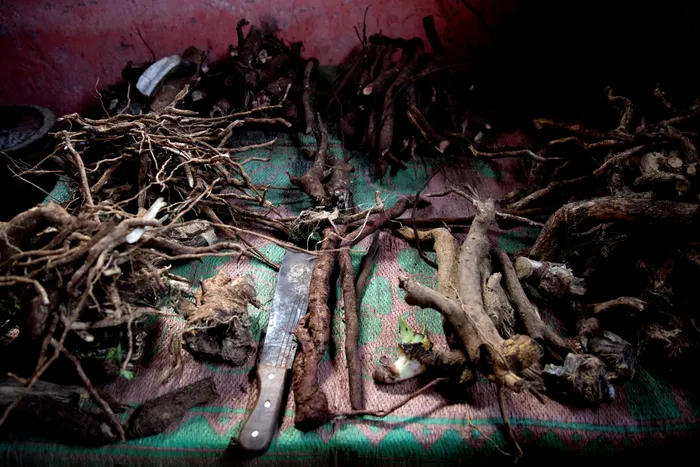
KZN’s new Empilweni Distribution Centre bridges the gap between ancient tradition and modern law by creating a regulated, sustainable market for the R20 billion traditional medicine sector.
Image: Reuters / Nicky Woo
KwaZulu-Natal’s government has moved to formalise and expand the province’s traditional medicine sector with the launch of the Empilweni Distribution Centre, positioning it as both an economic driver and a conservation intervention.
The facility, launched by Economic Development, Tourism and Environmental Affairs (EDTEA) MEC Musa Zondi, is intended to regulate the supply of medicinal plants and animal byproducts while supporting traditional health practitioners with legally sourced, quality-controlled materials.
Zondi said the centre responds to systemic challenges that have long defined the sector, including illegal harvesting, unregulated trade, and biodiversity loss.
“We faced serious operational challenges… unregulated selling and buying, increasing illegal harvesting inside protected areas, and circulation of fake or poor-quality medicinal products,” he said.
The hub will centralise the storage and distribution of medicinal plants, seeds, and processed materials, with all products certified and traceable. It will also manage permit verification and compliance, shifting the sector from what Zondi described as a “reactive, enforcement-focused” approach to a “preventative, structured, collaborative” system.
But beyond regulation, academics say the initiative could unlock significant economic potential.
Professor Ngceba Gqaleni of the University of KwaZulu-Natal said traditional medicine remains an undervalued industry despite its scale.
“Traditional medicine has been undermined, yet it has an important economic value to our country. It is estimated to be worth about R20 billion a year,” Gqaleni said.
He added that this figure reflects largely informal trade and could increase significantly with formalisation.
“When it’s formalised, we think it’s actually more. And with now cannabis coming on board, we think that this industry is going to grow,” he said.
Gqaleni, who was commissioned by the provincial government between 2014 and 2016 to develop a strategy for the sector, said the current initiative builds on earlier research that identified traditional medicine as a viable agro-processing industry.
“We said it is possible to create an agro-processing [sector]… we can create a factory to produce tablets, not just products wrapped in newspaper or bottles, but properly packaged,” he said.
He outlined a broader value chain that includes cultivation, manufacturing, and research. Certain medicinal plants, he noted, are suited to regions such as the Drakensberg, opening opportunities for farming and job creation.
“We can create jobs in farming… some of these plants are suitable to the Drakensberg area, so you can create farms in those areas,” he said.
Gqaleni also pointed to ongoing scientific work aimed at integrating traditional medicine into formal healthcare systems. He said research teams are currently conducting clinical trials on herbal treatments developed by local practitioners.
“If the product gets registered and the science is good, we have a blockbuster product. It’s going to disrupt the industry,” he said.
He further highlighted the sector’s overlooked role in tourism, noting that patients travel from different parts of South Africa and abroad to seek traditional healing.
“That aspect we have not even quantified,” he said.
Ezemvelo KZN Wildlife CEO Sihle Mkhize said the Empilweni centre will function as more than a warehouse. It will include a permitting system, a research and library component, and a nursery where medicinal plants are cultivated and traditional healers are trained in sustainable harvesting practices.
“We are also issuing the permits… we have a library section where people can learn about these different species… and space for researchers,” Mkhize said.
The nursery component is aimed at reducing pressure on wild plant populations by enabling cultivation at the community level.
The centre is expected to be fully operational within a week, with plans to expand into a provincial network of distribution points over the next five years.
Zondi said the initiative reflects a broader policy shift linking economic development, environmental protection, and indigenous knowledge systems.
“Sustainable conservation is impossible without community ownership,” he said.