

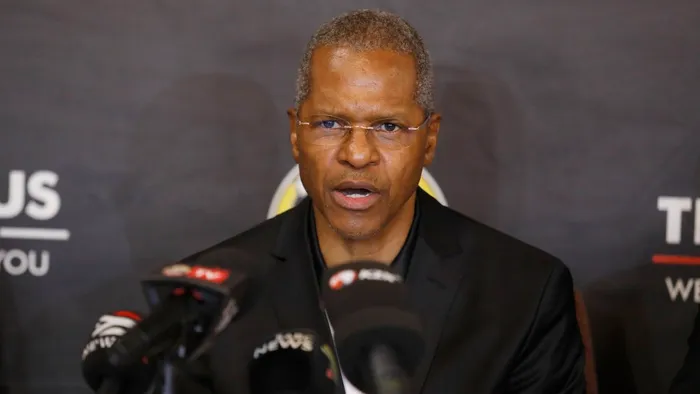
Velenkosini Hlabisa
Image: Doctor Ngcobo/ Independent Newspapers
The IFP has vowed not to be taken by surprise again in the upcoming local government elections after its “victory” was scuppered by the emergence of the uMkhonto weSizwe Party (MKP) in the last general elections.
Party leader Velenkosini Hlabisa said the IFP is paying close attention to findings from surveys and research to ensure that what transpired during the national government elections does not repeat itself.
Political analysts concurred with Hlabisa, saying the IFP had appeared on track to outperform most parties during the 2024 elections.
Hlabisa spoke of the IFP's ambitions while addressing editors and journalists of Independent Media last week. He touched on the party’s plan for growth, the estimated number of branches, and those joining the party, as well as its work to prepare for the conference heading into the local government elections.
He said the emergence of the MKP, which he described as a “revolution”, had destabilised the party's plans. The party leader revealed that heading into the national government elections in 2024,the IFP had been confident of victory in KwaZulu-Natal.
“The emergence of the MKP disturbed us; I would describe what transpired there as a revolution,” said Hlabisa.
The party leader stated that the MKP was able to reach disenchanted non-voters and bring them out to vote for them. “That is the definition of a revolution, as it brings out all the unhappy people to come out and take action,” he said.
“There has been research that pointed to that MKP threat, but we had not paid any attention to that research and wondered where that was coming from. But this time, we are paying attention to everything, including the research,” said Hlabisa.
Hlabisa said were it not for the emergence of the MKP, the IFP would have done very well, as the results had shown that of all the parties that competed, the IFP was the only one that did not lose any votes.
“We had to decide between campaigning all over the country or concentrating in one area, and we decided to concentrate in one area, and that worked out well for us,” he said.
Hlabisa said the IFP is still popular, pointing out that in the past few years, the party had won more than 40 by-elections and was attracting members from diverse backgrounds, breaking the stereotypes associated with the party.
“The IFP was seen as a party that attracted uneducated people that carried sticks; that stereotype is gone. That it was a party for Zulu people; we now have councillors in Mpumalanga and Gauteng. It was a party for the elderly, but we now have younger people, so all the stereotypes about the party are gone,” he said.
Political analyst Siyabonga Ntombela said the IFP was on track to outperform parties like the EFF, DA, and even the ANC, especially in KZN.
He said there are several issues that the IFP is getting right that resonate with the public.
“There is noticeable good performance in the by-elections. The IFP can be confident they will do well in the local government elections. What the IFP is doing right is, first, handling internal party politics.
“IFP factionalism is not obvious to the public but only known within the party. There is professional handling of internal disagreements and factional squabbles, which other parties are failing dismally to do.”
He said fewer corrupt IFP leaders appear on TV or are mentioned in ad hoc committees and commissions of inquiry. This strengthens the party's reputation as the least corrupt party. He added that leaders of the IFP are generally not seen to be defending corruption and those implicated.
“The performance of Mr Thami Ntuli in the province of KZN, his support of Ms Mbali (Mbali Shinga, MEC of Social Development), and provincial police commissioner Nhlanhla Mkhwanazi in their quest to make KZN a performing province—these are some of the many good points that make the IFP win by-elections: the ability to read the voters’ demands,” he said.
For more stories from The Mercury, click the link THE MERCURY