

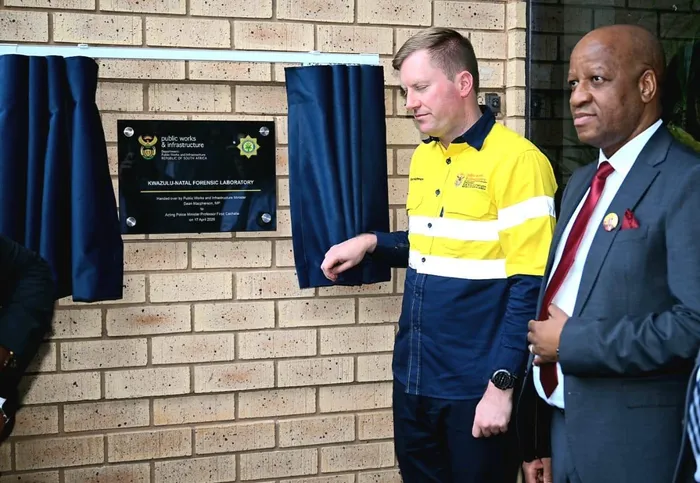
KwaZulu Natal Premier Thami Ntuli and Minister Dean McPherson celebrate the official opening of the Mayville Forensic Science Laboratory
Image: Supplied
KwaZulu-Natal is set to end its reliance on Pretoria and the Western Cape for DNA processing, as the newly handed-over Mayville Forensic Science Laboratory (FSL) moves toward becoming a "turnkey solution" for the province's justice system.
The facility, officially handed over by Public Works and Infrastructure Minister Dean McPherson on Friday, will finally bring biology, chemistry, and questioned document units under one roof, alongside specialised quality management staff.
For years, KZN has functioned primarily as a site for "evidence recover", with actual DNA analysis having been outsourced to labs thousands of kilometres away. Officials revealed on Friday that this logistical hurdle is about to end.
"When the lab is equipped with DNA processing units, we’ll be able to have a turnkey solution in this province," a forensic representative explained. "There will be no movement of any exhibit from here to any other province."
The scale of the challenge facing the new facility was laid bare with the release of the latest forensic data. As of yesterday, the province has 24,442 cases on hand. Of those, 13,861 are officially classified as backlogs, having remained unresolved for more than 90 days.
A breakdown of the backlog reveals the pressure points in the KZN justice chain:
Premier Thami Ntuli and Minister McPherson emphasised that consolidating these units into a secure, flood-proof facility in Mayville is a strategic move to protect evidence and accelerate these timelines.
"Forensic science transforms suspicion into certainty," Ntuli said, noting that for victims of gender-based violence and other violent crimes, the reduction of these over13,000 backlog cases is the only way to restore trust in the legal system.
Minister McPherson added that the Department of Public Works is no longer just a "landlord" but a partner in policing. "We may not wear the uniform, but we can deliver the infrastructure that strengthens the hand of the police," he said.
The move to centralise operations is expected to drastically improve command and control, according to SAPS Provincial Commissioner, Lieutenant General Nhlanhla Mkhwanazi.
While acknowledging that the laboratory still requires further equipment and machinery—which SAPS is currently procuring—Mkhwanazi noted that having analysts housed under one roof would immediately begin to reduce turnaround times for evidence processing.
"The DPP (Director of Public Prosecutions) is here and can attest that there are thousands of backlog cases not finalised in court because of forensic delays," Mkhwanazi said.
"We must consolidate the toolkit and put all evidence in place to make the work of the prosecution easier."
For more stories from The Mercury, click the link THE MERCURY